Episode Introduction
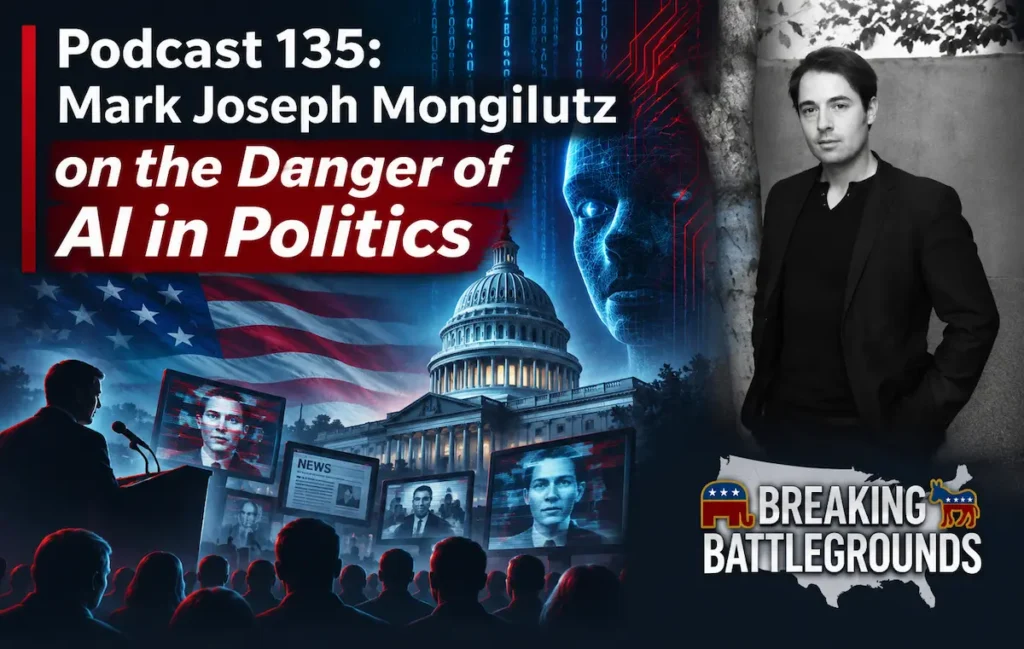
Scottsdale writer and Army Old Guard veteran-author Mark Joseph Mongilutz returned to Breaking Battlegrounds in 2023 to discuss a column he wrote for the show: “How to Prevent AI from Tricking Us in the 2024 Election.”
More than a year before voters went to the polls, Mongilutz warned that AI-generated deepfakes could be used to confuse Americans about how, when and where to vote. He argued that ordinary voters could protect themselves with a few simple habits.
Later in the episode, Jimmy Quinn, National Review’s national security correspondent and a China specialist, joined Sam Stone and Chuck Warren to discuss the threat China poses to the United States.
Quick Answer
In Breaking Battlegrounds Podcast 135, writer Mark Joseph Mongilutz discussed his column on how AI deepfakes could mislead voters in the 2024 election. He urged voters to check official election websites and to be skeptical of digital content that feels “not quite real.” National Review’s Jimmy Quinn also discussed the national security threat posed by China.
Episode Overview
The episode has two segments. In the first, Mongilutz explains the concerns behind his Breaking Battlegrounds column. In the second, Quinn discusses China.
Mongilutz’s column framed AI election deception as a problem for the whole country, not one party. His focus wasn’t persuasion ads. It was the risk that fake election guidance could reach voters who have long been able to trust the official information they receive.
About Mark Joseph Mongilutz
Mark Joseph Mongilutz is a writer, editor, author and ghostwriter based in Scottsdale, Arizona. He wrote Solemn Duty in the Old Guard: From Arlington National Cemetery to the Pentagon on 9/11 in America’s Oldest Regiment (2018). He also edited Voices of the 9/11 Pentagon Recovery Effort: Essays from the U.S. Army’s Old Guard (2020). Both books are published by McFarland.
At the time of this episode, he was content manager for Haymaker, a finance-focused Substack newsletter, where he has also interviewed market commentators. Originally from Western Washington, he is a returning Breaking Battlegrounds guest and a contributor to the show’s Substack.
About Jimmy Quinn
Jimmy Quinn is the national security correspondent for National Review, which he joined in 2020 as a Buckley Political Journalism Fellow. He covers China extensively. He was named a 2023-24 Robert Novak Journalism Fellow by The Fund for American Studies for a project on the Chinese Communist Party’s malign influence in America. He is a graduate of Columbia University and Sciences Po.
Key Topics Discussed
- AI deepfakes and the 2024 election
- How voters can protect themselves from AI-generated deception
- Why AI misinformation is a nonpartisan threat
- The national security threat China poses to the United States
Why Mongilutz Saw AI Deception as a Threat to Everyone
In his column, Mongilutz argued that AI could be used to spread confusion among Americans who have long been able to trust the election guidance they receive.
He also warned that if the response to AI deception split along party lines, building effective safeguards could stall for years. In his view, the danger wasn’t about which party might gain or lose. Large-scale deception harms everyone.
How Voters Can Spot an AI Deepfake
The column offered practical advice. Mongilutz pointed to the “uncanny valley,” the robotics term for the sense that something meant to look real isn’t quite right. He suggested that years of heavy CGI in movies have trained people to notice that feeling.
His most concrete recommendation was to rely on official election and commission websites to separate fact from fiction. He also noted that deepfakes exist only on screens, so verifying information through official, offline channels remains a reliable defense.
China and U.S. National Security With Jimmy Quinn
In the episode’s second segment, Quinn joined the hosts to discuss the threat China poses to the United States. His reporting at National Review has focused on Chinese Communist Party influence operations, espionage and intellectual property theft, and human rights in Hong Kong.
What Happened in the 2024 Election
Mongilutz’s warning proved partly prescient. Before the January 2024 New Hampshire primary, an AI-generated robocall imitating President Biden’s voice told voters not to participate. In February 2024, major technology companies announced an accord at the Munich Security Conference committing to detect and respond to deceptive AI election content.
By most accounts, the worst fears didn’t materialize. Analysts at Lawfare concluded that bad actors used AI relatively ineffectively to disrupt the 2024 U.S. elections. They credited AI labs’ safeguards and public policy responses.
Key Takeaways
- Mongilutz framed AI election deception as a nonpartisan threat to public trust.
- His main concern was fake election guidance, not persuasion ads.
- He argued that voters’ instinct for the “uncanny valley” is a useful first defense.
- His most practical advice was to verify information through official election websites.
- The 2024 election saw real AI incidents, but analysts found less disruption than many had feared.
Related Breaking Battlegrounds Episodes
- AI and politics:
- Election security: Election security and global upheaval
- China:
Frequently Asked Questions
Who is Mark Joseph Mongilutz?
Mark Joseph Mongilutz is a Scottsdale, Arizona writer, editor and ghostwriter. He is the author of Solemn Duty in the Old Guard (2018) and editor of Voices of the 9/11 Pentagon Recovery Effort (2020), both about the U.S. Army’s Old Guard. He has written columns for Breaking Battlegrounds and appeared on the show as a returning guest.
What did Mark Joseph Mongilutz say about AI and the 2024 election?
In his Breaking Battlegrounds column, Mongilutz warned that AI deepfakes could spread false election guidance and confuse voters. He argued it was a threat to all Americans, not one party. He recommended checking official election and commission websites and trusting the instinct that something feels “not quite real.”
Did AI disrupt the 2024 election?
There were real incidents, including an AI-generated robocall imitating President Biden before the New Hampshire primary. Overall, though, analysts found that bad actors used AI relatively ineffectively to disrupt the 2024 U.S. elections, partly because of safeguards adopted by AI companies and election officials.
Who is Jimmy Quinn?
Jimmy Quinn is a national security correspondent for National Review, which he joined in 2020 as a Buckley Political Journalism Fellow. He reports extensively on China, and he was a 2023-24 Novak Fellow at The Fund for American Studies, studying Chinese Communist Party influence in America.
Conclusion
In 2023, before most voters were thinking about deepfakes, Mongilutz argued that AI deception threatened trust in elections across party lines and that simple habits could protect voters. The 2024 cycle showed the threat was real but manageable. His advice to verify information through official sources applies just as much to the elections ahead.
Sources
- Breaking Battlegrounds: How to Prevent AI from Tricking Us in the 2024 Election
- McFarland: Solemn Duty in the Old Guard
- The Fund for American Studies: 2023-24 Novak Fellows
- Philadelphia Inquirer: Deepfakes and the 2024 election
- Lawfare: Why AI did not upend the super-year of elections
Editorial Note: This article is intended for informational and analytical purposes. Political developments, policies, polling, and public statements can change over time. Readers should consult primary sources and official government information for the latest details.