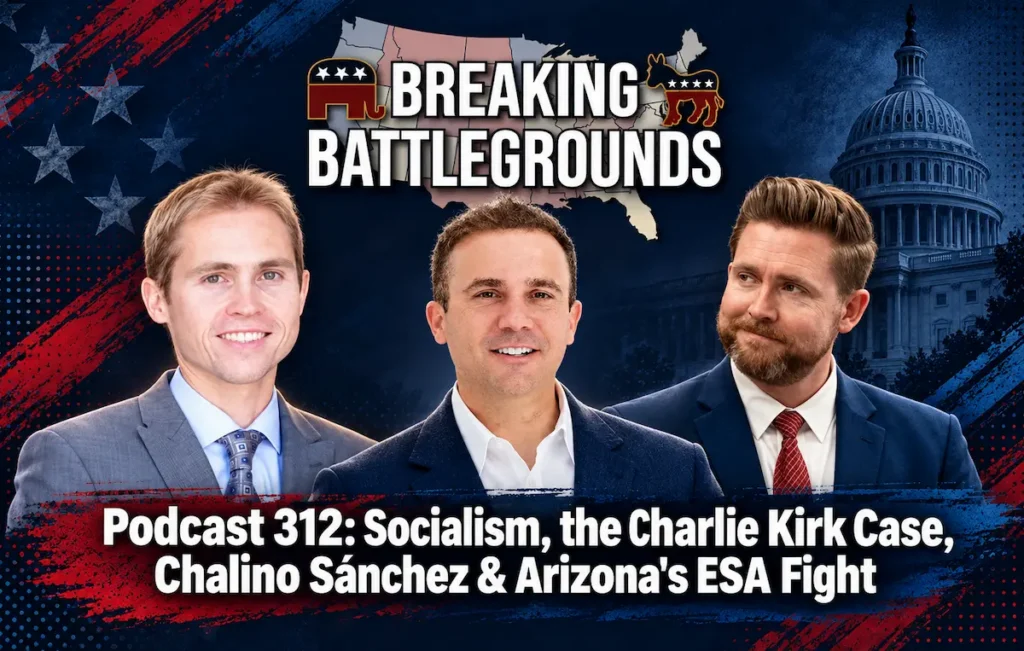
Episode Introduction
In July 2026, Breaking Battlegrounds covered five stories in one episode. Former prosecutor and Senate chief of staff Chuck Flint argued that price controls make housing and healthcare scarcer, and examined who funds anti-ICE protests. He also explained the procedural stakes of the death penalty case against the man accused of killing Charlie Kirk.
Matt Beienburg of the Goldwater Institute described the fight over Arizona’s Empowerment Scholarship Account program, which was then headed toward the November ballot. Nic Dunn of the Sutherland Institute presented a plan to merge federal assistance programs into a single benefit. In B’s Crime Corner, the show revisited the 1992 killing of corrido singer Chalino Sánchez.
Quick Answer
Breaking Battlegrounds Podcast 312, released in July 2026, features Chuck Flint on price controls, protest funding and the Charlie Kirk murder case; Matt Beienburg on Arizona’s ESA voucher ballot fight; and Nic Dunn on federal “empowerment accounts.” It also covers the 1992 killing of Chalino Sánchez. Since the episode aired, neither ESA measure qualified for Arizona’s November 2026 ballot.
Episode Overview
The episode moves from national economic policy to criminal justice, true crime, Arizona education policy and welfare reform.
Chuck Flint opens by arguing that government price controls, using New York’s rent rules and the Affordable Care Act as examples, tend to raise costs and reduce supply. He ties that argument to the rise of democratic socialist politicians such as Zohran Mamdani. He then discusses reporting on how anti-ICE protests are organized and funded, and explains what to watch for in the Charlie Kirk case as it reached its preliminary hearing.
B’s Crime Corner tells the story of Chalino Sánchez, the Mexican corrido singer killed in Culiacán in May 1992.
Matt Beienburg explains the teachers union initiative to restrict Arizona’s ESA program and the Republican-backed constitutional amendment meant to protect military families’ scholarship funds. He also covers two race-discrimination ballot measures and the role of outside money in initiative campaigns.
Nic Dunn closes the show with a proposal to consolidate federal assistance programs, and a discussion of artificial intelligence’s benefits and risks.
About the Guests
Chuck Flint is a former prosecutor and former chief of staff in the U.S. Senate. He is affiliated with the Alliance for IRS Accountability. He has appeared on Breaking Battlegrounds before, including an episode on taking on the IRS.
Matt Beienburg is Director of Education Policy at the Goldwater Institute and Director of its Van Sittert Center for Constitutional Advocacy. He is one of the most prominent defenders of Arizona’s universal ESA program.
Nic Dunn is Vice President of Strategy and a Senior Fellow at the Sutherland Institute, a Utah-based public policy think tank. He hosts the podcast “Defending Ideas.”
B hosts Breaking Battlegrounds’ true crime segment, B’s Crime Corner.
Key Topics Discussed
- Price controls, rent regulation and the Affordable Care Act
- The rise of socialist candidates, including New York City’s Zohran Mamdani
- Reporting on the funding behind anti-ICE protests
- Death penalty procedure in the Charlie Kirk murder case
- The 1992 killing of corrido singer Chalino Sánchez
- Arizona’s ESA voucher program and competing ballot measures
- Consolidating federal assistance into “empowerment accounts”
- Artificial intelligence and public policy
Why Price Controls Backfire, According to Chuck Flint
Flint argued that when government caps prices, it reduces the supply of what it is trying to make affordable. He pointed to New York’s rent rules as an example of controls discouraging new housing and maintenance, and to the Affordable Care Act as an example of market interference raising costs. He connected that argument to growing support for democratic socialist politicians such as Mamdani, who campaigned on freezing rents for stabilized apartments.
Supporters of rent stabilization argue that it protects existing tenants from displacement and sudden increases. Many economists warn that broad rent controls reduce housing supply over time.
Who Funds the Protests?
Flint discussed reporting on how anti-ICE demonstrations are organized and funded, with particular attention to Neville Roy Singham. A 2023 New York Times investigation described Singham, a former tech executive, as the center of a funding network that the paper said promotes Chinese government talking points through American nonprofits.
Singham has called that reporting a misleading hit piece. He says he does not work for, take instruction from, or receive funding from the Chinese government or Communist Party, and that he has never been a party member.
The Charlie Kirk Case and Death Penalty Procedure
Charlie Kirk was shot and killed on September 10, 2025, at a Turning Point USA event at Utah Valley University. Prosecutors are seeking the death penalty against the accused, Tyler Robinson.
Drawing on his prosecutorial experience, Flint explained why capital cases move slowly. He described the procedural safeguards required in death penalty cases and the steps prosecutors take to make a conviction hold up on appeal. He also argued that poorly managed court dockets contribute more to backlogs than a shortage of judges.
What happened next: Robinson’s five-day preliminary hearing opened in July 2026. Prosecutors presented campus surveillance video, messages they described as a confession, and a recorded interview with Robinson’s former roommate. In September 2026, Robinson was ordered to stand trial on seven charges, including aggravated murder, and he entered not guilty pleas. Prosecutors have proposed a 2028 trial. The defense has said a six- to seven-month trial could not begin until 2029, citing the obligations of capital defense. Erika Kirk has publicly called the 2029 timeline absurd. Flint’s point about the length of capital cases is now the central dispute in the case.
B’s Crime Corner: The Final Hours of Chalino Sánchez
Chalino Sánchez built a following in the late 1980s and early 1990s with corridos, ballads about violence, survival, the drug trade and the people around him. In May 1992, during a performance in Culiacán, Sinaloa, he was filmed reading a note passed to him onstage. Many fans believe the note was a death threat. Hours later, armed men reportedly took him away, and his body was found the next morning. His killing has never been officially solved.
Arizona’s ESA Ballot Fight, With Matt Beienburg
Beienburg described the campaign by the Arizona Education Association and Save Our Schools Arizona to restrict the ESA program, which serves about 100,000 students. Their initiative, the Protect Education Act, would have limited vouchers to families earning $150,000 or less and stopped unused funds from rolling over indefinitely. Supporters said it would add oversight to a program they consider poorly accountable. Beienburg warned that it would cut eligibility and claw back money families had saved for future education costs.
Beienburg also explained the Republican response: a constitutional amendment protecting scholarship funds for military families. Because it would be in the state Constitution, it could override the initiative if voters approved both. Opponents called it a “poison pill” designed to cancel the initiative.
What happened next: The initiative campaign submitted more than 420,000 signatures in early July 2026. The Arizona Supreme Court later found the measure, Proposition 212, did not have enough valid signatures. Courts also removed the military family measure, Proposition 145. As a result, no ESA measure is on Arizona’s November 2026 ballot, and the fight has moved to legislative races.
The conversation also touched on two other Arizona ballot measures dealing with race-based discrimination and on whether voters get enough information about who funds initiative campaigns.
Empowerment Accounts, With Nic Dunn
Dunn presented the Sutherland Institute’s “empowerment accounts” proposal, which would combine several federal assistance programs into one monthly benefit. He argued that the change would reduce administrative complexity. He said it would also ease benefit cliffs, where a small raise causes a family to lose more in benefits than it gains in income, which can discourage people from working more or earning more.
He closed with a balanced take on artificial intelligence, discussing its potential benefits and its social and economic risks, and explained how Sutherland uses podcasts and video to make policy research accessible.
Key Takeaways From the Conversation
- Chuck Flint argued that price controls reduce the supply of what they are meant to make affordable.
- Flint predicted that death penalty safeguards would make the Kirk case a slow process. The current 2028 to 2029 trial timeline bears that out.
- Matt Beienburg described Arizona’s ESA fight as a contest between a union-backed initiative and a GOP constitutional amendment. In the end, courts kept both off the ballot.
- Nic Dunn’s empowerment accounts proposal is aimed at the benefit cliffs that can penalize low-income families for earning more.
Listen to the Episode
- YouTube: https://www.youtube.com/@BreakingBattlegrounds
- Live on air: 960 AM in Phoenix, Saturdays at 9:00 a.m.
Related Breaking Battlegrounds Episodes
Chuck Flint previously joined the show to take on the IRS. For earlier coverage of the Kirk case, see the episode on Charlie Kirk trial costs with Andrew Gould. The show examined Mamdani’s housing agenda in Mamdani’s manufactured crisis. On school choice, Patrick Byrne discussed Mississippi’s education gains. For other 2026 Arizona races, see the episode on Arizona’s treasurer race.
Frequently Asked Questions
Will Arizona’s ESA voucher program be on the November 2026 ballot?
No. The Arizona Supreme Court found that the teachers union-backed Protect Education Act, Proposition 212, did not have enough valid signatures to qualify. Courts also removed the GOP-backed military family measure, Proposition 145. No ESA-related measure appears on the November 3, 2026 ballot.
What is the status of the Charlie Kirk murder case?
Tyler Robinson was ordered in September 2026 to stand trial on seven charges, including aggravated murder, for the September 10, 2025 shooting of Charlie Kirk at Utah Valley University. He has pleaded not guilty. Prosecutors are seeking the death penalty and have proposed a 2028 trial. The defense projects 2029.
Who is Chuck Flint?
Chuck Flint is a former prosecutor and former U.S. Senate chief of staff who is affiliated with the Alliance for IRS Accountability. On Breaking Battlegrounds, he has discussed IRS oversight, price controls, protest funding and death penalty procedure in the Charlie Kirk case.
What are empowerment accounts?
Empowerment accounts are a Sutherland Institute proposal to combine several federal assistance programs into one monthly benefit. Supporters say this would simplify administration and reduce benefit cliffs, where earning more causes a family to lose more in benefits than it gains in income.
Who was Chalino Sánchez?
Chalino Sánchez was a Mexican corrido singer known for songs about violence, survival and the drug trade. In May 1992, after a performance in Culiacán, Sinaloa, during which he was filmed reading a note many believe was a threat, he was abducted by armed men and found dead the next morning. His killing remains unsolved.
Conclusion
Podcast 312 covered several policy fights at once. Some of its forward-looking segments have since been resolved. Chuck Flint’s warning that a capital case moves slowly is now playing out in the dispute over the Kirk trial date. Matt Beienburg’s ESA ballot fight ended in court, not at the ballot box. The episode is a useful record of how these debates were being framed in summer 2026, alongside an enduring true crime mystery and a welfare reform idea that remains open.
Related Reads
- Chuck Flint Takes On the IRS
- Andrew Gould on the Courts and Charlie Kirk Trial Costs
- Mamdani’s Manufactured Crisis
- Inside The Enemy Within with Patrick Byrne
Sources
- ABC15, “ESA reform measure Proposition 212 fails to make Arizona ballot” (2026)
- Phoenix New Times, “A guide to all the ballot measures Arizona voters will decide in 2026”
- Arizona Mirror, “Voucher oversight initiative turns in 420k signatures” (July 2, 2026)
- KJZZ, “Arizona group submits signatures to get ESA initiative on November ballot” (July 6, 2026)
- KTAR, coverage of the lawsuit over the military family ESA measure (2026)
- CNN, coverage of Tyler Robinson’s preliminary hearing (July and September 2026)
- Deseret News, “Tyler Robinson doesn’t anticipate trial until 2029” (October 22, 2026)
- Fox News, “Erika Kirk rips ‘absurd’ 2029 trial timeline” (October 2026)
- The Wire, full statement from Neville Roy Singham (2023)
- Arizona Secretary of State, 2026 ballot measures: https://azsos.gov (recommended primary source)
- Utah State Courts, State v. Robinson docket (recommended primary source)
Editorial Note: This article is intended for informational and analytical purposes. Political developments, policies, polling, and public statements can change over time. Readers should consult primary sources and official government information for the latest details.