What Is a Swing State?
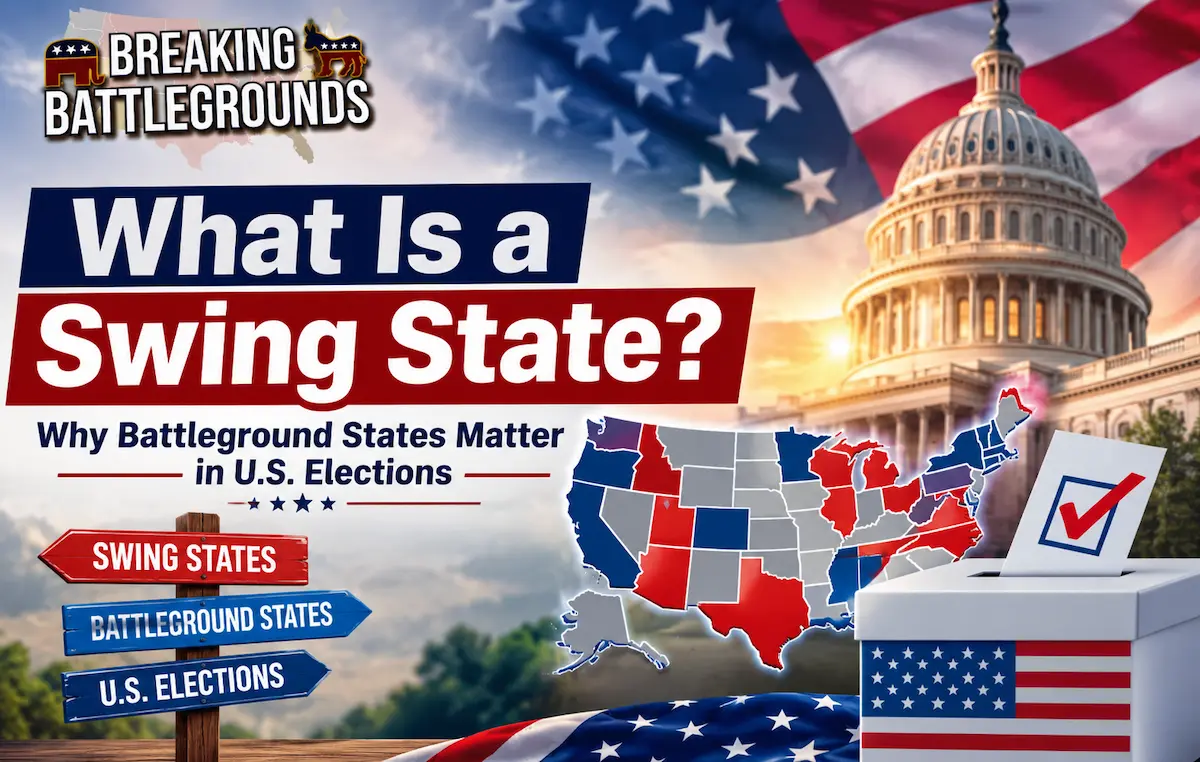
A swing state is a state where the outcome of a presidential election is genuinely in doubt. Neither party can count on it, and both campaigns treat it as winnable. That uncertainty is what separates a swing state from the roughly forty states whose results are predictable well before Election Day.
There is no official government list of swing states. No federal agency designates them, and no statute defines the term. It is a political and analytical label used by campaigns, journalists, and election forecasters such as the Cook Political Report, Sabato’s Crystal Ball, and Inside Elections. These organizations look at recent election margins, polling averages, and demographic trends to decide which states belong in the category, and they do not always agree on the exact list.
Analysts typically flag a state as competitive when the expected margin between the two major parties falls within about five points. Some tighten that threshold to three points for a stricter definition. Either way, the label reflects a judgment call based on evidence, not a formal classification.
A state’s status can and does change. Arizona voted Republican in every presidential election from 1952 through 2016 except 1996, then became a genuine battleground starting in 2020. North Carolina was reliably Republican for decades before turning into one of the tightest states in the country during the 2000s and 2010s. The list a political writer would have produced in 2004 looks nothing like the list from 2024.
What Is a Battleground State?
Swing state and battleground state are used almost interchangeably in political coverage, and readers should not look for a meaningful distinction between them. Both describe a state where either party has a real chance of winning.
Purple state carries a slightly different connotation. It usually describes a state’s overall political identity, a mix of red Republican and blue Democratic areas, rather than its status in a single election cycle. A state can be purple in a demographic sense while leaning toward one party in actual results for a stretch of elections.
Competitive state is the broadest of the four terms. Analysts sometimes use it for statewide races below the presidential level, such as Senate or governor’s contests, even in states that are not presidential battlegrounds. Georgia’s 2026 Senate race and Ohio’s 2026 governor’s race, discussed later in this article, are examples of races drawing battleground-level attention in a non-presidential year.
Why Do Swing States Matter?
Swing states matter because of arithmetic, not sentiment. A presidential candidate needs 270 electoral votes to win, and most states are locked in for one party years before the election. That leaves a handful of states to actually decide the race, and campaigns respond by pouring resources into exactly those places.
In 48 states and the District of Columbia, the candidate who wins the statewide popular vote takes all of that state’s electoral votes. Maine and Nebraska are the exceptions, splitting some votes by congressional district. Under the winner-take-all system, a candidate who wins a battleground state by 10,000 votes gets exactly the same electoral haul as one who wins it by a million. That is why campaigns will spend tens of millions of dollars chasing a margin of one percentage point. According to the National Archives, the Electoral College has determined every presidential election since its creation, and its all-or-nothing structure at the state level is precisely what makes narrow, contested states so valuable.
Because of that structure, a candidate can win the presidency while losing the national popular vote, as happened in 2000 and 2016. That possibility is exactly why campaigns build their strategy around state-by-state paths to 270 rather than around the national vote total. Advertising budgets, staff deployments, and candidate travel schedules all follow the electoral map, not the popular vote polling.
Electoral College Connection
Each state’s electoral vote total equals its number of U.S. House seats plus its two senators. That means larger states carry more weight, which is part of why Pennsylvania, with 19 electoral votes, draws more campaign attention than Nevada, which has 6. The current electoral vote counts were set by the 2020 Census and apply through the 2028 election. The next reapportionment will not take effect until after the 2030 Census.
A useful way to see the stakes: Trump’s 312 electoral votes in 2024 came from adding the seven core battlegrounds, worth 93 electoral votes combined, to states that were never seriously contested. Flip enough of those 93 votes to the other side, and the outcome changes. That concentration of decisive power in a small group of states is the entire reason swing states dominate campaign strategy.
How Are Swing States Determined?
No single factor makes a state competitive. Analysts weigh several inputs together, and the mix shifts from cycle to cycle.
- Recent presidential election margins, especially how close the last one or two cycles were
- Polling averages heading into the current race
- The share of registered voters who are independent or unaffiliated with either major party
- Voter turnout patterns, including whether turnout has been rising or falling among key groups
- Demographic change, such as growth in suburban, Latino, or college-educated populations
- The urban-rural split within the state and how it is trending
- Historical voting trends going back multiple decades, not just recent elections
- Candidate strength and how well a specific nominee performs with the state’s electorate
- Salient political issues, such as abortion, immigration, or the economy, that resonate differently by state
- National and state-level economic conditions at the time of the election
Forecasters like Cook Political Report and Sabato’s Crystal Ball combine these inputs into race ratings that run from Solid to Toss-Up. Those ratings shift throughout a campaign as new polling and events change the picture, which is why the swing-state list published in January of an election year often looks different by November.
What States Are Considered Swing States?
The seven states widely treated as the core presidential battlegrounds heading into 2028, based on their 2024 margins and historical volatility, are listed below. This list reflects current analysis and can shift as the next presidential cycle develops.
State | Electoral Votes | Recent Competitiveness | Why It Matters |
Pennsylvania | 19 | Decided by 1.71 points in 2024 (Trump) after Biden won it by a similar margin in 2020 | The largest of the core battlegrounds. Its winner has taken the presidency in every election since 1988. |
Georgia | 16 | Trump won by roughly 2 points in 2024, reversing Biden’s narrow 2020 win | A Sun Belt state that has flipped in consecutive cycles depending on turnout and coalition shifts. |
North Carolina | 16 | Has voted Republican in every presidential race since 2008 except 2008 itself, but margins stay tight | Consistently close statewide, even when the presidential winner is not in serious doubt. |
Michigan | 15 | Trump won by 1.42 points in 2024; the state flipped in three straight cycles before that | Part of the traditional Blue Wall with Pennsylvania and Wisconsin. |
Arizona | 11 | Trump’s 2024 margin widened to roughly 5.8 points after Biden’s 2020 win by just 10,457 votes | A former reliably Republican state that has become genuinely contested since 2020. |
Wisconsin | 10 | Decided by under 1 point in each of the last three presidential elections | The smallest statewide swing of any 2024 battleground, showing durable, even competition. |
Nevada | 6 | Trump’s 2024 win ended a run of Democratic wins dating to 2004 | A smaller electoral haul, but consistently in play due to a diverse, mobile electorate. |
Beyond these seven, states such as Minnesota, New Hampshire, Virginia, and Florida have shown competitive margins in at least one recent cycle and are being watched by analysts for whether they drift toward battleground status. None of them currently carries the same consistent, cycle-over-cycle competitiveness as the core seven.
Swing States in Recent Presidential Elections
Looking at the last three presidential cycles shows how quickly the map can move. In 2016, Donald Trump broke a Democratic winning streak in Michigan, Pennsylvania, and Wisconsin that in some cases dated back decades, while also carrying North Carolina, Georgia, and Arizona, which were considered reliably Republican at the time.
In 2020, Joe Biden flipped Arizona and Georgia, both traditionally Republican, while also winning back Michigan, Pennsylvania, and Wisconsin. North Carolina was the one 2016 Trump state he did not capture. Biden’s win in Arizona came by just 10,457 votes, and Georgia by fewer than 12,000, among the closest state results in modern presidential history.
In 2024, Trump reversed all six of those results, sweeping Pennsylvania, Georgia, Arizona, Michigan, Wisconsin, and North Carolina while also winning Nevada, a state Democrats had carried in five straight elections. Wisconsin was decided by 0.86 points, the closest of the seven, while Arizona showed the largest rightward shift at roughly 5.8 points. None of this guarantees how these states behave in 2028. It shows that recent competitiveness, not permanent identity, is what defines a swing state.
Why Campaigns Spend So Much Money in Swing States
Campaign budgets follow the electoral map with striking precision. A voter in Philadelphia or Phoenix will see a volume of presidential advertising that a voter in a safely Democratic or Republican state simply will not, because a single persuadable voter in a battleground state is worth far more to a campaign’s electoral math than a voter in a state whose outcome is not in question.
- Television and digital advertising, which typically consume the largest share of battleground budgets
- Door-to-door canvassing operations run by campaigns and allied outside groups
- Phone banking and text messaging programs aimed at persuasion and turnout
- Fundraising events and appeals specifically tied to battleground-state contests
- Candidate and running-mate appearances, often dozens of stops in a single state
- Local media interviews and earned coverage in battleground markets
- Voter registration drives targeted at persuadable or infrequent voters
- Get-out-the-vote operations built around early voting and Election Day logistics
This spending gap can be dramatic. Pennsylvania and Michigan were the two most-visited states of the 2024 cycle for both major candidates, while most states saw no campaign stops at all. A safe state might see a single visit tied to a fundraiser. A battleground state can see fifty or more combined appearances from the top of both tickets.
Swing States and the 2026 Elections
There is no presidential race in 2026, so the traditional presidential battleground list is not directly on the ballot this year. The concept still applies, however, to the Senate, House, and governor’s races that will decide control of Congress and dozens of statehouses.
Republicans currently hold a 53 to 47 Senate majority, and Democrats need a net gain of four seats to retake control. According to Cook Political Report, Georgia and Michigan, both Democratic-held seats, rank among the most competitive Senate races of the cycle, while Maine and North Carolina, both Republican-held, are considered Democrats’ best pickup opportunities. Notably, three of those four states, Georgia, Michigan, and North Carolina, are also core presidential battlegrounds, showing how the same underlying competitiveness carries over from presidential to midterm politics.
Governor’s races add another layer. Cook Political Report has rated five 2026 gubernatorial contests as toss-ups, and Arizona’s race, where Democratic incumbent Katie Hobbs is seeking reelection, has moved from toss-up toward Democrats in recent ratings updates, while Ohio’s open seat shifted from lean Republican to toss-up over the summer of 2026. These midterm dynamics do not predict what happens in the 2028 presidential race, but they confirm that several of the same states remain genuinely contested up and down the ballot.
Swing States vs. Safe States
The table below summarizes the practical differences between a battleground and a state where the outcome is not seriously in question. Safe state, like swing state, is an informal political term rather than an official designation.
Feature | Swing State | Safe State |
Election competitiveness | High | Lower |
Expected margin | Often narrow, frequently under 3 points | Often larger, sometimes double digits |
Campaign attention | High | Usually lower |
Advertising spending | Heavy, often the bulk of national ad budgets | More limited |
Candidate visits | Frequent, sometimes dozens per cycle | Less frequent |
Electoral importance | Potentially decisive on its own | Depends on the overall electoral map |
Can a Swing State Decide a Presidential Election?
Yes, and recent history offers direct examples. In 2020, Biden’s combined margin across Arizona, Georgia, and Wisconsin totaled roughly 43,000 votes out of more than 21 million cast in those three states. Had a small enough share of voters in each state gone the other way, the Electoral College outcome would have flipped despite Biden’s seven-million-vote national popular vote lead.
Consider a simple hypothetical. If two candidates are separated by a handful of electoral votes heading into the final states to report, and one battleground state holds exactly the number of electoral votes needed to cross 270, winning that single state determines the entire presidency. This is not a prediction about any future race. It illustrates why campaigns treat certain states as existential rather than merely helpful.
Swing States and Voter Turnout
Turnout carries extra weight in a competitive state because small shifts in who shows up can change the outcome, unlike in a safe state where turnout swings rarely alter the result. Campaigns in battlegrounds build entire operations around identifying registered voters who might not otherwise vote and getting them to the polls.
Independent and unaffiliated voters draw particular attention in swing states because they are, by definition, not locked into either party. Early voting and mail voting have become larger shares of the electorate in most battlegrounds over the past decade, giving campaigns a longer window to bank votes rather than relying entirely on Election Day turnout. States vary widely in how they administer early and mail voting, and those rules can shape campaign strategy as much as the electorate itself.
Demographic turnout differences, such as how suburban voters, rural voters, or specific age cohorts turn out relative to their share of registration, are closely tracked by both parties in battleground states. These patterns shift from election to election and should not be assumed to favor one party permanently.
Related Breaking Battlegrounds Discussion
Breaking Battlegrounds has covered swing-state dynamics directly on multiple occasions. In a crossover episode ahead of the 2024 election, hosts Sam Stone and Chuck Warren were joined by political analyst Chris Cillizza and Arizona consultant Constantin Querard to break down pivotal battleground races from Pennsylvania to Arizona. In a separate episode, Cillizza returned alongside American Greatness editor Liz Sheld to discuss polling trends across the swing states and why the 2024 race remained difficult to call until the final weeks. Listeners who want a closer look at how one battleground state actually runs its elections can also check out the conversation with Maricopa County Recorder Stephen Richer on the administration side of Arizona’s elections.
Frequently Asked Questions
What is a swing state?
A swing state is a state where the outcome of a presidential election is genuinely uncertain because both major parties have a realistic chance of winning it. The term is a political and analytical label, not an official government classification, and the specific list of swing states shifts from one election cycle to the next.
What does swing state mean?
It means a state’s electorate is closely divided enough between the two parties that recent elections have been decided by narrow margins, typically under five percentage points. Analysts such as Cook Political Report and Sabato’s Crystal Ball use polling, past results, and demographic trends to identify which states currently fit that description.
Why do swing states matter?
They matter because the Electoral College is winner-take-all in 48 states, so a state’s electoral votes go entirely to whichever candidate wins it, even by a single vote. Most states are locked in for one party well before Election Day, leaving a small group of competitive states to actually decide the presidency.
What is the difference between a swing state and a battleground state?
There is no meaningful difference. Both terms describe a state where either major party has a realistic chance of winning, and political writers use them interchangeably. Purple state and competitive state are related terms that carry slightly broader or different connotations
How many swing states are there?
Analysts generally treat seven states, Pennsylvania, Georgia, North Carolina, Michigan, Arizona, Wisconsin, and Nevada, as the core presidential battlegrounds heading into 2028, based on their 2024 margins. A handful of additional states are watched closely for whether they join that group in future cycles.
Which states are considered swing states?
As of 2026, Pennsylvania, Georgia, North Carolina, Michigan, Arizona, Wisconsin, and Nevada make up the core group, together worth 93 electoral votes. Minnesota, New Hampshire, Virginia, and Florida have shown competitive margins recently and are being watched for whether they become consistent battlegrounds in 2028.
Conclusion
A swing state earns that label through evidence, close recent margins, competitive polling, and a genuinely divided electorate, not through tradition or assumption. The same handful of states have decided the last several presidential elections because the Electoral College hands all of a state’s electoral votes to whoever wins it, turning narrow contests into outsized prizes. That dynamic explains why campaigns spend disproportionately in these states, why candidates visit them dozens of times, and why the list itself keeps shifting as demographics and political coalitions change.
Understanding swing states is really about understanding how the Electoral College converts state-level results into a national outcome. Readers who want to follow the 2026 midterms and the eventual 2028 presidential race with real context should watch these same competitive states closely, since they tend to signal where American politics is actually moving, not just how the last election turned out.
Sources
- Wikipedia, 2024 United States presidential election, results and margins by state
- USAFacts, “What are the current swing states, and how have they changed over time?”
- Sabato’s Crystal Ball, “The Reapportionment of Votes in the Electoral College”
- Ballotpedia, “U.S. Senate battlegrounds, 2026” and “Presidential battleground states, 2024”
- The Hill, reporting on Cook Political Report 2026 gubernatorial rating changes
- Brookings Institution, “What the nation told us in 2024, state by state”
Editorial Note: This article is intended for informational and analytical purposes. Political developments, election polling, laws, and election information can change over time. Readers should consult official election authorities for the latest information.