Published: February 14, 2025 | Runtime: 1:06:44 | Hosts: Sam Stone and Chuck Warren
Episode Introduction
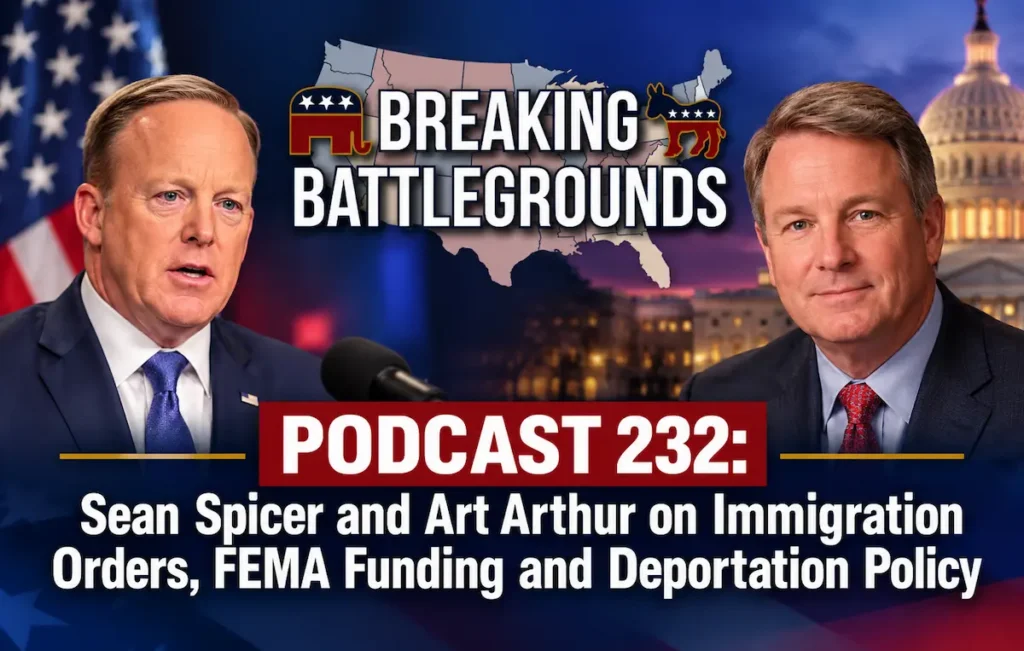
Sean Spicer and Art Arthur bring two very different vantage points to the first weeks of President Trump’s second term. Spicer ran the White House briefing room in 2017. Arthur spent years deciding deportation cases from the bench.
On Podcast 232 of Breaking Battlegrounds, Spicer talks with Sam Stone and Chuck Warren about the administration’s immigration executive orders, the left’s response to DOGE, and early polling on Trump and possible 2028 Democratic contenders. Arthur explains FEMA’s role in migrant funding, the tariff threats then on the table, and the international agreements that shape where deportees can be sent.
Two more guests round out the hour. Washington Free Beacon reporter Aaron Sibarium describes how universities are renaming DEI programs instead of ending them, and entrepreneur Kurt Gilbreth talks about competing in high-stakes poker tournaments.
Quick Answer
On Breaking Battlegrounds Podcast 232, released February 15, 2025, former White House press secretary Sean Spicer discussed Trump’s immigration executive orders, DOGE, and 2028 polling. Former immigration judge Art Arthur of the Center for Immigration Studies explained FEMA’s role in migrant funding, proposed tariffs, and the international agreements shaping U.S. deportation policy.
Episode Overview
This episode was recorded during the first month of the second Trump administration, when immigration enforcement, federal spending cuts, and trade threats were all moving at once. Each guest covers a different part of that period.
Spicer opens with the political picture. He looks at the immigration executive orders, how Democrats and their allies were reacting to the Department of Government Efficiency, and what early polling suggested about Trump’s standing and the emerging 2028 Democratic field.
Arthur then turns to the legal and operational side of immigration. His segment covers FEMA’s part in funding migrant services, the administration’s proposed tariffs as leverage, and the agreements with other countries that determine whether deportations can actually be carried out.
Sibarium’s reporting moves the conversation to higher education. He explains how some universities were relabeling diversity, equity and inclusion offices and programs to avoid scrutiny without changing what those programs do.
The show closes on a lighter note. Gilbreth, an entrepreneur and tournament poker player, describes the preparation and stakes behind World Poker Tour competition.
About the Guests
Sean Spicer
Spicer served in President Trump’s first-term White House, named press secretary on December 22, 2016 and taking office with the inauguration on January 20, 2017. Before that, he was communications director of the Republican National Committee from 2011 to 2017 and its chief strategist from 2015 to 2017. He also worked for the United States Trade Representative and several members of Congress, graduated from the U.S. Naval War College, and is a commander in the U.S. Navy Reserve. He currently hosts The Sean Spicer Show.
Andrew “Art” Arthur
Arthur is the Center for Immigration Studies’ Resident Fellow in Law and Policy, a role he took in April 2017. His judicial experience is directly relevant to this episode: he served as an immigration judge at the York Immigration Court in Pennsylvania, hearing thousands of deportation, removal, exclusion, and bond cases and ruling on asylum applications. Earlier, he was acting chief of the INS National Security Law Division, overseeing prosecutions of alien terrorists, persecutors, and spies. He has testified before Congress more than 15 times.
Aaron Sibarium
Sibarium is a staff writer at the Washington Free Beacon, graduated from Yale, where he was opinion editor of the Yale Daily News, and previously edited at The American Interest. His reporting contributed to the resignation of former Harvard president Claudine Gay.
Kurt Gilbreth
Gilbreth is an entrepreneur who competes in high-stakes poker tournaments, including events on the World Poker Tour.
Key Topics Discussed
- Trump’s immigration executive orders in the first weeks of his second term
- Democratic and progressive reactions to DOGE
- Early polling on President Trump and potential 2028 Democratic candidates
- FEMA’s role in funding migrant shelter and services
- Tariffs as leverage in immigration and border negotiations
- International agreements that determine where deportees can be sent
- Universities renaming DEI programs under new titles
- Competing in high-stakes World Poker Tour events
Sean Spicer on Executive Orders, DOGE and 2028 Polling
Spicer’s segment examines the politics of the administration’s fast start. The opening executive orders on immigration were the headline, but he spends just as much time on how opponents chose to respond to DOGE and what that response revealed about Democratic strategy.
He also reviews early polling. In February 2025, the 2028 Democratic field was still taking shape, so the discussion is about positioning and possible contenders rather than declared campaigns.
Art Arthur on FEMA, Migrant Funding and the Shelter and Services Program
The FEMA question was in the news the week this episode aired. Elon Musk posted that the DOGE team had found $59 million sent by FEMA to New York City hotels housing migrants, and DHS fired four FEMA officials, including the agency’s chief financial officer, two program analysts and a grant specialist.
The money came from a program most voters had never heard of. FEMA administers the Shelter and Services Program in partnership with Customs and Border Protection to help cities shelter migrants, and Congress appropriated $650 million for it in fiscal year 2024. The two sides disputed how the money was used: of the $59.3 million, $19 million covered direct hotel costs, with the rest going to services such as food and security. New York officials also said the city never paid luxury hotel rates.
As a former immigration judge, Arthur explains where FEMA fits in a system that most people associate with ICE and Border Patrol.
Tariffs, Foreign Agreements and Whether Deportations Can Happen
A deportation order only matters if another country will take the person. Arthur’s segment focuses on that practical constraint and connects it to the tariff threats the administration was using in early 2025.
He walks through the international agreements that determine whether removals can happen at scale. Listeners who follow immigration mostly through border numbers will find this the most useful part of the episode.
Aaron Sibarium on Universities Renaming DEI Programs
Sibarium has covered elite institutions for years, and his segment addresses a practice he has documented repeatedly: changing the name of a DEI office or program while leaving its function in place.
Later reporting showed the same pattern. In April 2025, for example, he reported that Caltech had given its top diversity official a new title while keeping the DEI office intact. The episode captures his view of this trend at its early stage, a few weeks into the administration’s crackdown.
Kurt Gilbreth on High-Stakes Poker
The last segment shifts away from policy. Gilbreth explains what it takes to compete against thousands of players in a World Poker Tour event, from bankroll decisions to the mental stamina that long tournament days require.
Key Takeaways From the Conversation
- The first month of Trump’s second term put immigration enforcement, federal spending cuts, and trade policy in the news at the same time, and this episode covers all three.
- FEMA’s Shelter and Services Program became a political flashpoint after the DOGE disclosure in February 2025, and Arthur provides the legal background behind that fight.
- Deportation policy depends on agreements with other governments as much as on enforcement in the United States.
- Sibarium’s reporting suggests that some universities responded to DEI pressure by renaming programs rather than ending them.
Listen to the Episode
You can listen to Podcast 232 on the Breaking Battlegrounds Substack, or search “Breaking Battlegrounds” on Apple Podcasts, Spotify, or YouTube.
Related Breaking Battlegrounds Episodes
Arthur’s Center for Immigration Studies colleague Todd Bensman appeared a few weeks earlier, in Podcast 226, to discuss the national security risks of open-border policies. The week before this episode, Montana’s attorney general covered border enforcement from a state perspective in Podcast 231: Attorney General Knudsen on Montana’s Fentanyl Epidemic.
For more on higher education and the reversal of progressive policies, listen to Podcast 229 with Ilya Shapiro, CFO Jimmy Patronis and Rep. Greg Steube. Podcast 228 with Congressman Buddy Carter covers how Republicans planned to keep momentum behind the administration’s agenda.
Frequently Asked Questions
What did Sean Spicer discuss on Breaking Battlegrounds?
In Podcast 232, released February 15, 2025, Sean Spicer talked with hosts Sam Stone and Chuck Warren about President Trump’s immigration executive orders, the left’s reaction to the Department of Government Efficiency, and early polling on Trump and possible 2028 Democratic candidates. He spoke from his experience as a former White House press secretary and RNC chief strategist.
Who is Art Arthur?
Andrew “Art” Arthur is the Resident Fellow in Law and Policy at the Center for Immigration Studies. He is a former U.S. immigration judge who served at the York Immigration Court in Pennsylvania, previously led the INS National Security Law Division as acting chief, and has testified before Congress more than 15 times.
What did Art Arthur say about FEMA and migrant funding?
Arthur explained FEMA’s role in funding migrant services, which drew national attention in February 2025 after DOGE flagged $59 million in Shelter and Services Program payments to New York City. He also covered proposed tariffs and the international agreements that determine whether U.S. deportations can be carried out.
What is the FEMA Shelter and Services Program?
The Shelter and Services Program is administered by FEMA in partnership with U.S. Customs and Border Protection. It reimburses cities and organizations for sheltering and serving migrants. Congress appropriated $650 million for it in fiscal year 2024, and it became a political flashpoint in early 2025.
Where can I listen to the Sean Spicer and Art Arthur episode?
Podcast 232 is available on the Breaking Battlegrounds Substack, Apple Podcasts, Spotify, iHeart, Amazon Music, and the Breaking Battlegrounds YouTube channel. The full episode runs 1 hour, 6 minutes and 44 seconds.