The Northern Border: An Undercovered Crisis
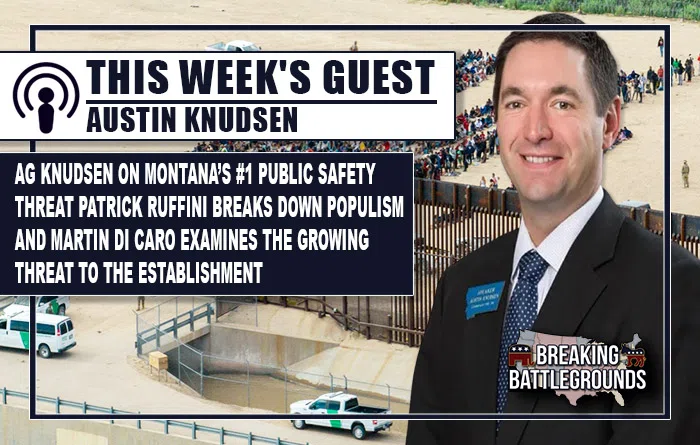
Public and media attention to the U.S. fentanyl crisis has focused overwhelmingly on the southern border, where the majority of seized fentanyl enters the country. But Montana Attorney General Austin Knudsen, appearing on Breaking Battlegrounds Episode 231, described a northern border fentanyl problem that has received far less federal enforcement attention and almost no national media coverage.
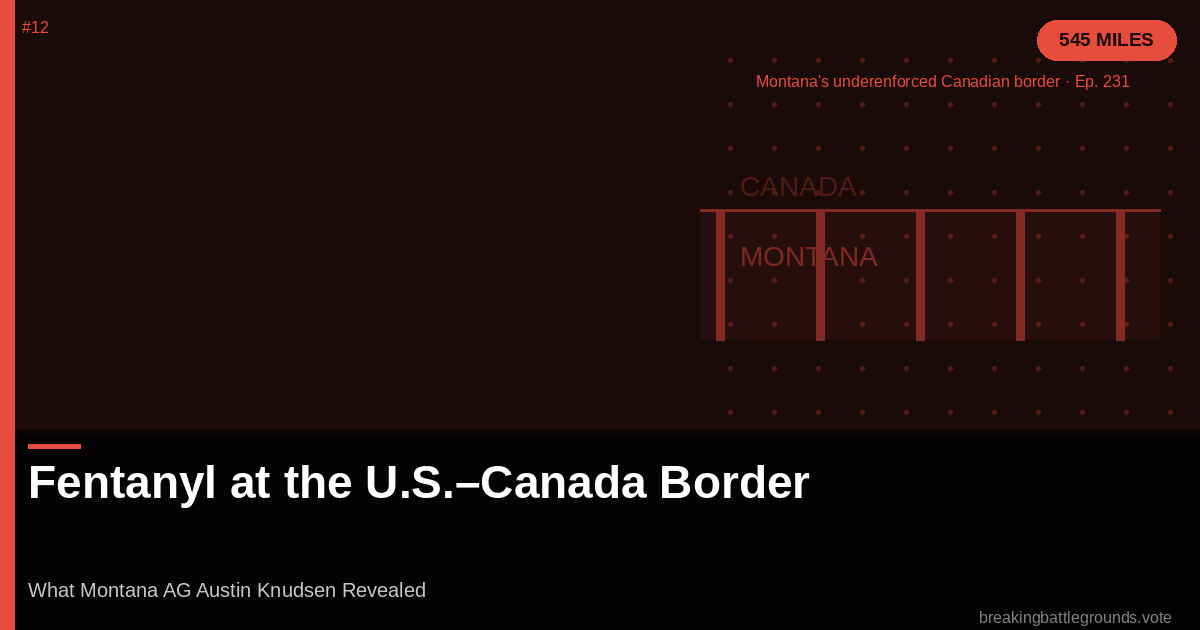
Knudsen’s core point: the same criminal networks that use Canada as a transshipment point for other contraband have identified the northern border’s comparatively light enforcement posture as a trafficking corridor. Montana’s geography, sharing 545 miles of border with Canada, much of it in remote areas, makes it a particular target.
What Knudsen Revealed About Montana's Fentanyl Problem
Knudsen described fentanyl seizures in Montana that were traced to Canadian origin points, a pattern that state law enforcement had identified but that federal enforcement resources had not prioritized to the same degree as southern border seizures. He noted that the per-capita fentanyl death rate in rural Montana is disproportionately high relative to population size.
The enforcement challenge Knudsen identified is structural: the northern border has fewer customs agents per mile than the southern border, tribal lands that span the border create jurisdictional complexity, and the remote terrain means detection technology is harder to deploy and maintain.
The Policy Argument Knudsen Made
Knudsen’s policy argument was direct: federal border security resources and attention should not be exclusively concentrated on the southern border when documented trafficking routes exist in the north. State attorneys general have limited resources to address a federally classified border enforcement problem. Montana cannot unilaterally close a federal border.
He called for proportional federal investment in northern border infrastructure, additional Customs and Border Protection agents in northern sectors, and improved intelligence sharing between federal agencies and state law enforcement in border states.
Why This Matters for the National Drug Policy Debate
The fentanyl crisis is primarily framed as a border security and China supply chain problem. Knudsen’s appearance on Breaking Battlegrounds added a dimension to that framing that policymakers have not adequately addressed: the northern border as a trafficking route that benefits from asymmetric enforcement attention.
A comprehensive fentanyl policy that focuses only on the southern border and Chinese precursor chemical supplies leaves a documented trafficking corridor insufficiently addressed. Knudsen’s testimony from direct law enforcement experience in Montana makes this argument with an authority that no think tank study can replicate.
Frequently Asked Questions
Is fentanyl coming through the U.S.-Canada border?
Yes. Montana Attorney General Austin Knudsen confirmed on Breaking Battlegrounds that Montana law enforcement has identified fentanyl trafficking routes through the northern border, with seizures traced to Canadian origin points.
Who is Austin Knudsen?
Austin Knudsen is the Attorney General of Montana, having been elected in 2020. Before serving as AG, he served in the Montana House of Representatives and as Roosevelt County Attorney.
Why does the northern border get less attention than the southern border for drug trafficking?
The northern border has fewer Customs and Border Protection agents per mile, more remote and difficult terrain, and has historically had lower seizure volumes than the southern border. Knudsen argues this enforcement asymmetry has created an exploitable trafficking corridor.