Why Immigration Policy Divides the Parties
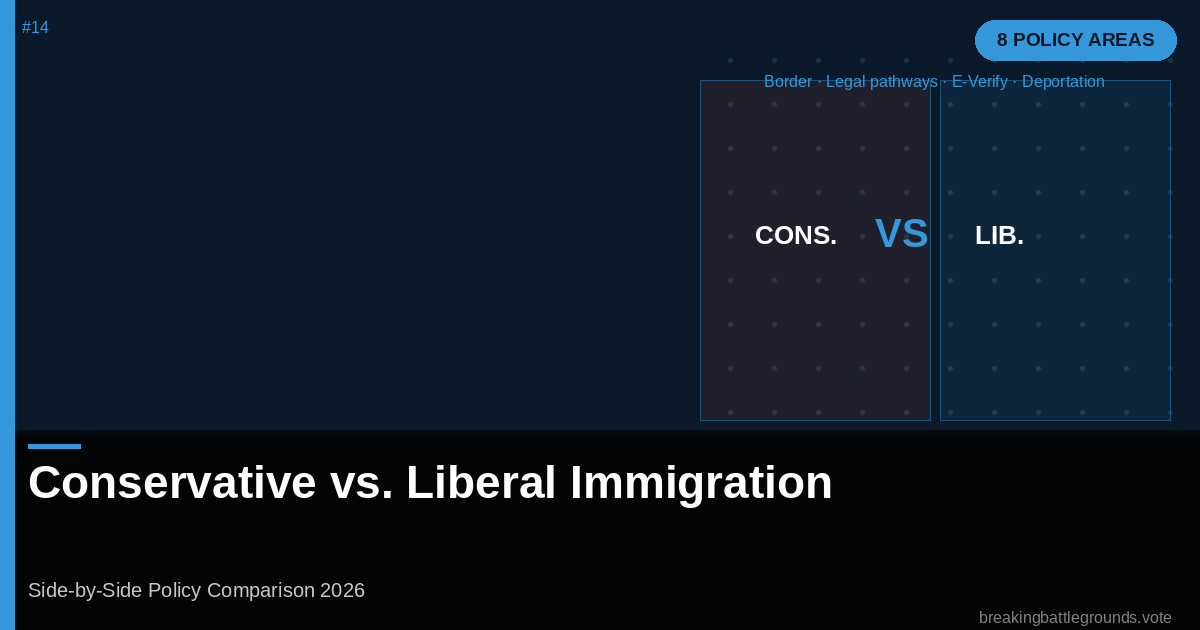
Immigration policy is one of the clearest areas of party differentiation in American politics. The difference is not merely about how many immigrants to admit, but about the framework for making immigration decisions: national interest vs. humanitarian obligation, enforcement-first vs. pathways-first, federal control vs. sanctuary jurisdiction discretion.
The comparison below draws on the stated platforms of each party, the policy records of each party’s administration, and the frameworks explained by former Immigration Judge Art Arthur on Breaking Battlegrounds Episode 232.
The Eight-Point Comparison
BORDER ENFORCEMENT
Conservative: Physical barrier construction, expanded Border Patrol, reinstatement of Remain in Mexico, mandatory detention of asylum seekers during processing.
Liberal: Humanitarian reception infrastructure, expanded asylum processing capacity, end to physical barrier construction, alternatives to detention.
LEGAL IMMIGRATION CRITERIA
Conservative: Shift from family-preference to merit-based (skills, education, occupational need), reduce chain migration categories, eliminate Diversity Visa Lottery.
Liberal: Maintain family-preference system, increase overall legal immigration numbers, expand DACA protections.
ASYLUM PROCESSING
Conservative: Expedited removal for claims without documentary support, return to country of first safe refuge, third-country processing agreements.
Liberal: Restore full asylum hearing process, end third-country agreements, increase immigration court capacity and funding.
DEPORTATION PRIORITIES
Conservative: Enforce removal orders for all individuals regardless of criminal history, expand interior enforcement, 287(g) agreements with local law enforcement.
Liberal: Focus enforcement resources on individuals with serious criminal convictions, limit interior enforcement, sanctuary jurisdiction policies.
E-VERIFY
Conservative: Mandatory E-Verify for all employers nationwide, criminal penalties for employers who hire unauthorized workers.
Liberal: E-Verify implementation paired with pathway to legal status for unauthorized workers already employed.
UNDOCUMENTED POPULATION
Conservative: Enforcement-first approach, no blanket amnesty, earned legal status only through compliance with existing law.
Liberal: Pathway to citizenship for long-term residents, DACA expansion, immediate protection from deportation for essential workers.
IMPORTED WORKER PROGRAMS
Conservative: Reform H-1B program to prioritize American workers, enforce wage protections, audit program for fraud.
Liberal: Expand H-1B visa numbers, streamline processing, reduce barriers for high-skilled immigration.
SANCTUARY POLICIES
Conservative: Federal enforcement in sanctuary jurisdictions, withhold federal funding from jurisdictions that refuse 287(g) participation.
Liberal: Local discretion on immigration enforcement cooperation, oppose federal coercion of local police.
Where the Parties Sometimes Agree
Both parties acknowledge that the legal immigration system has long backlogs that harm legitimate applicants. Both parties have expressed support, at various points, for some form of E-Verify modernization. Both parties have voted for border security funding, though they disagree on which components, physical barriers vs. technology and personnel, provide the best return.
The area of most consistent overlap: agricultural guest worker programs. Both parties have historically supported H-2A agricultural visas as a legal framework for seasonal agricultural labor needs.
Frequently Asked Questions
What is the main difference between conservative and liberal immigration policy?
The fundamental difference is the decision-making framework: conservatives prioritize national interest criteria (skills, economic need, security) and enforcement of existing law, while liberals prioritize humanitarian obligations and pathways to legal status for those already in the country.
Do conservatives want to reduce all immigration?
Not necessarily. Many conservative immigration proposals maintain or increase legal immigration numbers while shifting the criteria from family preference to merit-based selection. The emphasis is on changing who gets priority, not simply reducing total numbers.