What a Tariff Is
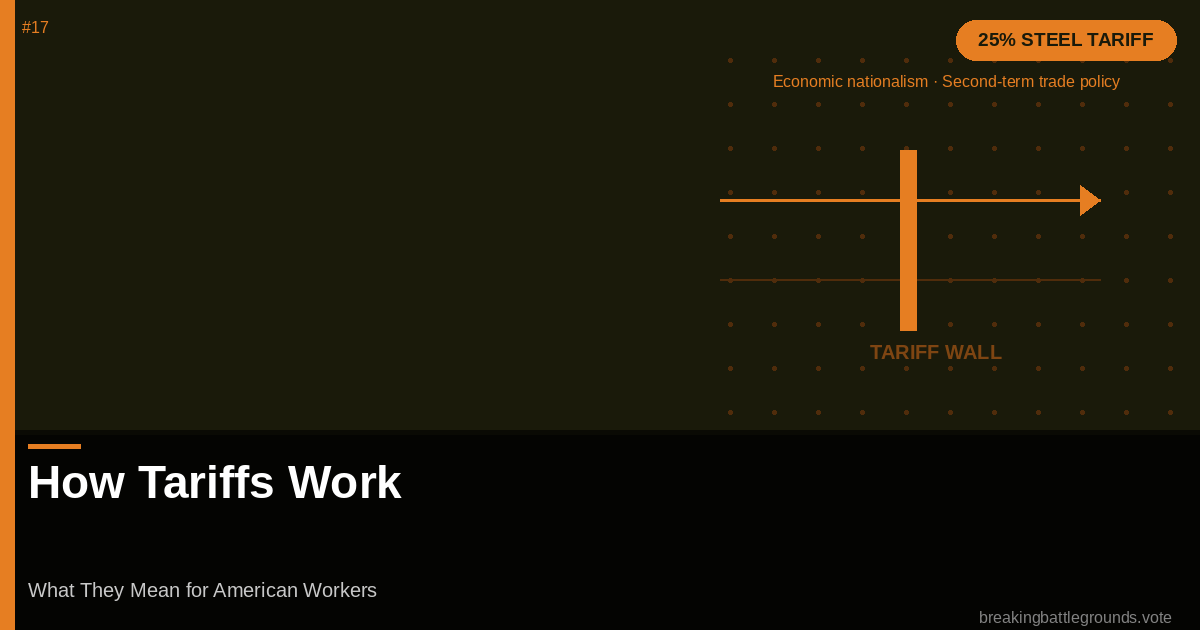
A tariff is a tax imposed by the importing country on goods coming in from abroad, collected at the point of entry. When the United States imposes a 25 percent tariff on steel from a particular country, American companies that import that steel pay 25 percent of its value as a tax to the U.S. government when it enters the country.
The tariff-paying company then faces a choice: absorb the cost as a reduction in profit margins, pass the cost to consumers through higher prices, or substitute domestic steel (which does not carry the tariff). In practice, most tariff costs are distributed across all three outcomes, some absorbed, some passed on, some redirected to domestic suppliers.
The Conservative Economic Nationalism Case for Tariffs
The economic nationalist argument for tariffs, the framework that has shaped Trump administration trade policy, makes four claims. First, some industries have strategic value that justifies protection regardless of short-term economic efficiency calculations. Steel and semiconductor manufacturing are the clearest examples: the ability to produce them domestically matters for national security even if it costs more than importing from lower-cost producers.
Second, other countries do not operate free trade. China’s state-subsidized industries compete against American companies that must earn a profit without government subsidy. Tariffs level the competitive field when the alternative is allowing state-subsidized competition to eliminate domestic industry.
Third, manufacturing employment carries social value beyond its wage contribution. Concentrated manufacturing communities, automotive in Michigan, steel in Pennsylvania, coal in West Virginia, have social fabric, institutional knowledge, and civic infrastructure that does not survive the loss of the anchor industry. Tariffs that preserve some domestic manufacturing preserve those communities.
Fourth, trade deficits matter because they represent a claim on future American production that accumulates over time. Persistent deficits with specific trading partners create structural economic dependencies that become strategic vulnerabilities.
The Conservative Free Trade Counter-Argument
Not all conservatives support tariff policy. The traditional conservative economic position favors free trade based on comparative advantage: countries should produce what they produce most efficiently, trade for everything else, and allow market prices to direct resource allocation without government interference.
The free trade objection to tariffs: they are taxes paid by American consumers and businesses, not by foreign exporters. When a steel tariff raises the price of American steel, every American manufacturer that uses steel, auto companies, construction firms, appliance makers, pays more. The benefit flows to steel workers; the cost is distributed across a much larger population of steel users.
The empirical record of the Trump first-term tariffs showed both effects: steel and aluminum production increased in the United States, and manufacturing jobs in those sectors stabilized or grew. Simultaneously, downstream manufacturing sectors that use steel and aluminum faced higher input costs, which reduced their competitiveness in some markets.
The Second-Term Tariff Agenda
The second Trump term has maintained first-term steel and aluminum tariffs, added new tariffs on Chinese goods in semiconductor-adjacent manufacturing categories, and imposed specific tariffs on electric vehicle components to protect domestic EV manufacturing development. The tariff structure in 2026 is more extensive than at any point in the post-WWII era outside of the early 1980s.
Frequently Asked Questions
What is a tariff?
A tariff is a tax on imported goods collected at the border by the importing country. American importers pay the tariff to the U.S. government when the goods enter the country.
Do tariffs hurt American consumers?
Tariffs raise costs for American businesses that import the tariffed goods and often raise consumer prices. The conservative economic nationalist argument holds that these costs are justified by the strategic and social benefits of preserving domestic manufacturing capacity.
What has the Trump administration tariffed?
The Trump administration has maintained tariffs on steel and aluminum, expanded tariffs on Chinese manufactured goods, and added sector-specific tariffs on electric vehicle components and semiconductor-adjacent manufacturing categories.