What Populism Is
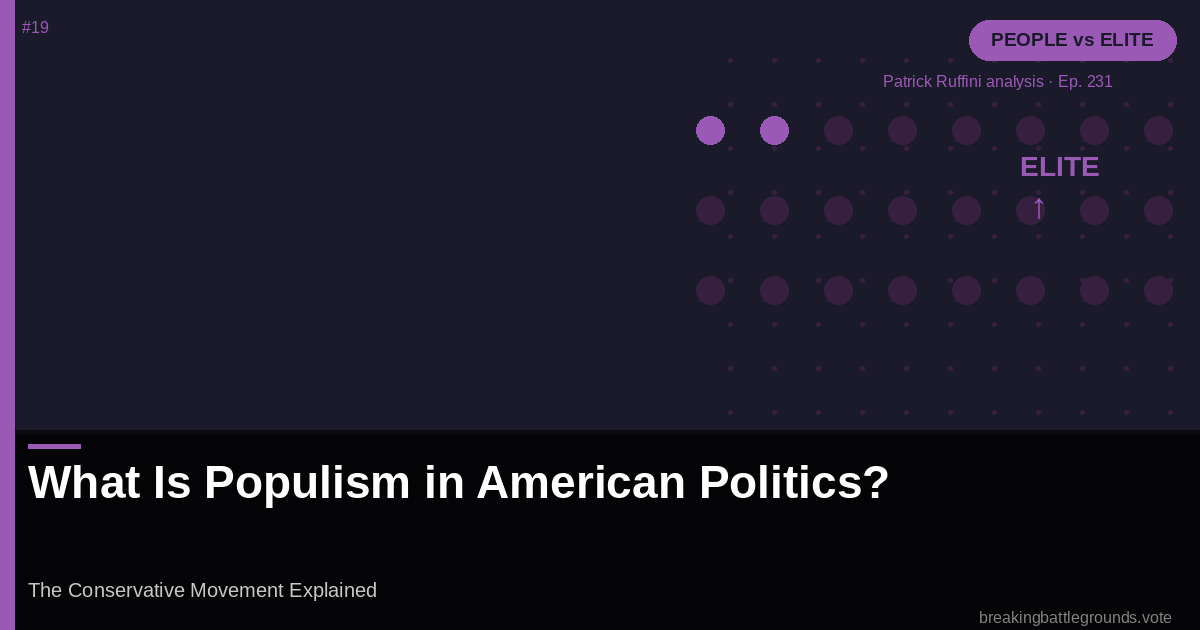
Populism is a political style or framework that divides society into two groups: an ordinary, virtuous people and a corrupt, self-serving elite. The populist political project is to return power to the people and displace the elite. In American politics, populism has appeared across the political spectrum, from William Jennings Bryan on the left to Pat Buchanan on the right, but it has most recently become the dominant framework of the Republican Party.
Patrick Ruffini, a political scientist and polling expert who appeared on Breaking Battlegrounds Episode 231, analyzed how populism has transformed conservative politics from a coalition organized around free markets, strong defense, and social conservatism into a coalition organized primarily around skepticism of institutional elites.
How Populism Changed the Republican Coalition
The pre-2016 Republican coalition was organized around three pillars: economic libertarianism (free markets, low taxes, deregulation), social conservatism (traditional values, religious liberty, opposition to abortion), and hawkish foreign policy (NATO, democratic promotion, American military primacy). Populism disrupted all three.
Ruffini’s analysis on Breaking Battlegrounds: the realignment of working-class voters toward the Republican Party has brought in constituencies that do not share the traditional free-market orientation. Working-class Republican voters support tariff protection, are skeptical of free trade agreements, and want government to play a more active role in managing economic outcomes for people like them. They are socially conservative but often economically interventionist.
This creates genuine tension within the Republican coalition between its traditional donor class (which favors free trade and lower corporate taxes) and its new populist voter base (which wants industrial policy, trade protection, and more aggressive use of government power against institutional elites).
The Conservative Critique of Populism
Not all conservatives embrace populism. The traditional conservative objection is that populism is a governing philosophy, and a bad one. Identifying an elite and blaming social problems on its malevolence does not produce workable policy. Government cannot function if it is organized primarily around resentment of institutions rather than around building effective institutions.
The conservative critique also notes that populism’s anti-institutional impulse can undermine the rule of law, independent courts, and the professional civil service that makes government function. These institutions are conservative in the original sense, they conserve order and predictability, and their erosion creates more disorder than it resolves.
Frequently Asked Questions
What is populism in American politics?
Populism is a political framework that divides society into an ordinary people and a corrupt elite, with the political project of returning power to the people. In American conservatism, it has become the dominant organizing framework of the Republican Party since 2016.
Is Trump a populist?
Yes. Trump’s political style, anti-institutional, anti-elite, focused on the grievances of working-class voters against a corrupt establishment, is textbook populism, adapted to the American right.
What is the difference between conservatism and populism?
Traditional conservatism emphasizes preserving institutions, incremental change, and skepticism of rapid reform. Populism is anti-institutional and is willing to use disruptive political methods to displace elites. The two overlap significantly in the contemporary Republican Party but are not identical.