Most podcasters leave significant revenue on the table, not because their audience is too small, but because they do not understand how podcast advertising is priced, what advertisers are actually paying for, and how to position their show to command premium rates. This guide covers the complete sponsorship rate landscape for 2026 and the negotiation tactics that move you from standard CPM to premium placement deals.
How Podcast Advertising Pricing Works
Podcast advertising is priced primarily on CPM, cost per mille, meaning cost per 1,000 downloads. An advertiser paying a $30 CPM for a show that delivers 10,000 downloads per episode pays $300 per episode for one ad placement. Multiple placements per episode multiply that figure.
The CPM model has a critical qualifier: most advertisers and networks measure CPM based on downloads within 30 days of episode publication, not total lifetime downloads. This means a show with high subscriber retention and fast download velocity commands higher effective CPMs than a show with the same total download number spread over a longer period.
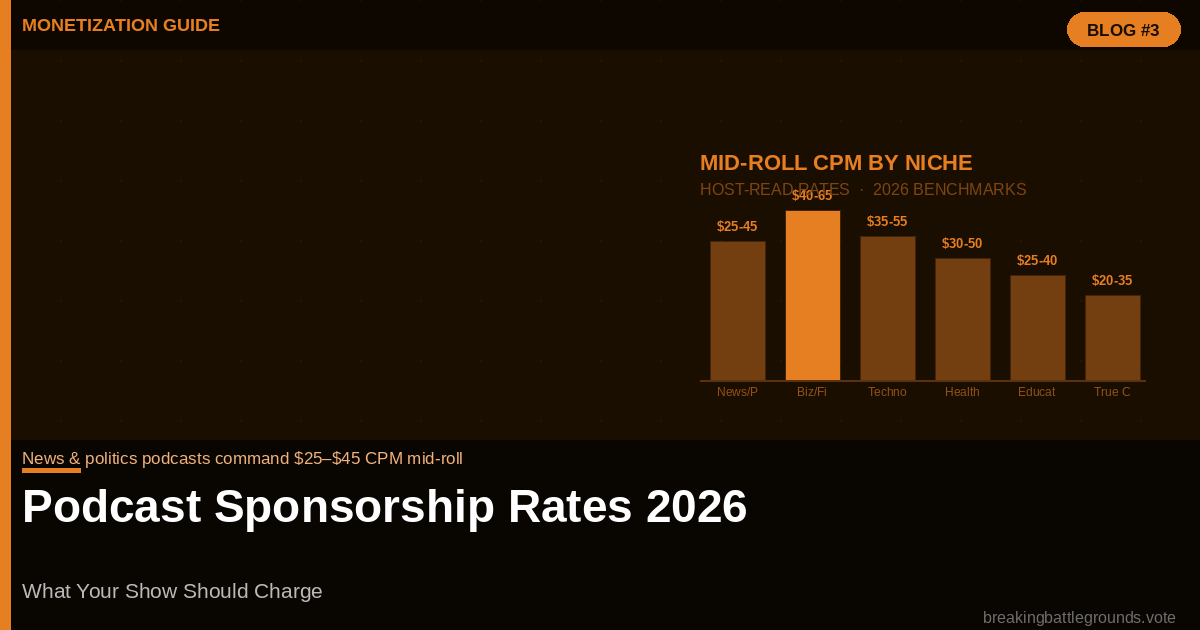
2026 CPM Rates by Podcast Niche
Niche | Pre-Roll CPM | Mid-Roll CPM | Host-Read Premium |
News & Politics | $20–$30 | $25–$45 | 15–25% above base |
Business & Finance | $30–$45 | $40–$65 | 20–35% above base |
Technology | $25–$40 | $35–$55 | 15–30% above base |
Health & Wellness | $20–$35 | $30–$50 | 10–20% above base |
True Crime | $15–$25 | $20–$35 | 10–15% above base |
Comedy | $12–$22 | $18–$30 | 5–15% above base |
Education | $18–$30 | $25–$40 | 15–20% above base |
Why Host-Read Ads Command Premium Rates
The podcast advertising industry’s core value proposition is host trust transfer, the listener’s trust in the host extends to products and services the host endorses. This trust transfer effect is what separates podcast advertising from banner ads, pre-roll video, or social media placements. A listener who has spent 200 hours with a host treats that host’s recommendation with a credibility weight that no paid placement can replicate.
Host-read ads leverage this trust transfer. A 60-second host-read mid-roll ad, the host speaking in their own voice about genuine experience with the product, outperforms a 30-second pre-recorded spot by 3 to 4 times on advertiser recall and conversion metrics. This performance premium is why host-read ads command 15 to 35 percent above base CPM rates.
Negotiating Beyond CPM: The Formats That Pay More
CPM is the baseline. Experienced podcasters negotiate three additional value layers on top of CPM rates. Category exclusivity means the advertiser is the only company in their product category running on your show, no competing brands. This exclusivity typically adds 20 to 40 percent to the base CPM because the advertiser gets uncontested mindshare.
Integrated segment sponsorship is a step beyond host-read: the advertiser funds a recurring segment of the show. The sponsor of Breaking Battlegrounds’s weekly election analysis segment, for example, has its brand associated with every mention of that segment across the episode, the show notes, and any promotional clips. Segment sponsorship rates are negotiated as flat monthly fees rather than CPM and typically run 2 to 4 times higher than equivalent CPM deals.
Annual contract discounts are the primary lever advertisers use to negotiate down from your rate card. A 20 percent discount on CPM in exchange for a 12-month commitment is a reasonable trade, you gain budget certainty and the advertiser gets loyalty pricing. Never discount more than 25 percent from your standard rate without a minimum 6-month commitment.
Frequently Asked Questions
What is CPM in podcast advertising?
CPM stands for cost per mille, the cost an advertiser pays per 1,000 downloads. A $30 CPM means the advertiser pays $30 for every 1,000 times the episode is downloaded. A show with 15,000 downloads per episode charges $450 for one 30-day ad placement at $30 CPM.
How many downloads do I need to get sponsors?
Most direct advertisers require 2,000 to 5,000 downloads per episode as a minimum. Podcast advertising networks like Podcorn and Advertise Cast work with shows as small as 500 downloads. Below that threshold, focus on affiliate marketing (commission-based) rather than CPM advertising.
What is the difference between pre-roll and mid-roll ads?
Pre-roll ads play before the episode content begins. Mid-roll ads appear in the middle of the episode, typically at a natural break. Mid-roll ads command 25 to 40 percent higher CPM rates because episode drop-off has already occurred by the mid-point, meaning mid-roll listeners are the most engaged segment of the audience.
Should I join a podcast ad network or sell ads directly?
Direct ad sales yield 100 percent of the ad revenue. Networks take 20 to 40 percent as their fee but handle all sales, billing, and advertiser relationships. Direct sales make sense for shows with established audiences and hosts willing to invest 5 to 10 hours per month in sales activity. Below 10,000 downloads per episode, a network’s volume discounts and access to larger advertisers usually outperform the economics of direct sales.