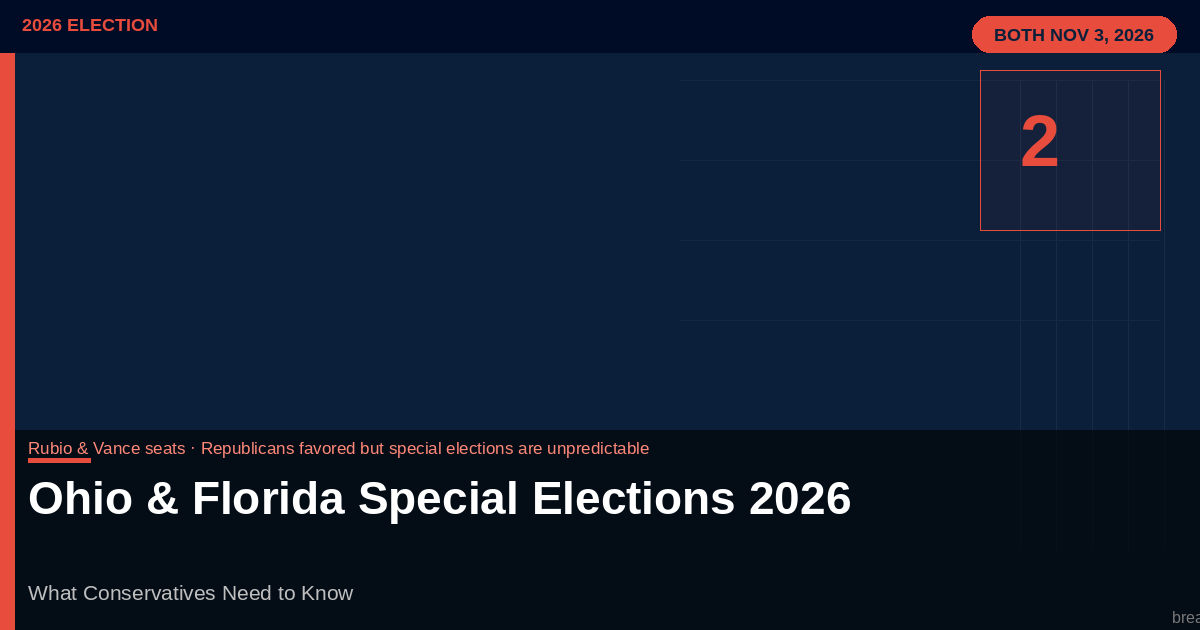
Why Two Seats Are Open
Marco Rubio resigned from the U.S. Senate to serve as Secretary of State in the second Trump administration. J.D. Vance resigned to serve as Vice President. Both vacancies required special elections rather than direct gubernatorial appointments to Senate seats — Florida and Ohio law both mandate elections to fill unexpired Senate terms.
The Florida Special Election
Florida went for Trump by 13 points in 2024. Republicans enter the special election as heavy favorites. The primary will determine whether the Republican nominee is a strong general election candidate or someone with primary-focused messaging that creates general election vulnerabilities.
Governor Ron DeSantis has significant influence over the Republican field. The candidate who secures his endorsement — or avoids his opposition — starts with a structural advantage in the primary. Democrats will contest the seat because a special election turnout model is different from a general election, and Florida’s Democratic base in Miami-Dade, Broward, and Palm Beach is reliably organized.
The Ohio Special Election
Ohio went for Trump by 11 points in 2024. Like Florida, Republicans are strong favorites. Ohio’s Republican primary has historically been more volatile — the state produced close
Republican primaries in 2022 (JD Vance’s own primary) and 2024. Candidate quality matters here more than in Florida.
Democrats’ most realistic play in Ohio is an exceptionally low-turnout special election where their motivated base outperforms a complacent Republican electorate. Conservative turnout operations in Ohio need to treat this like a general election, not a formality.
The Special Election Danger Republicans Ignore
Special elections operate on different turnout models than general elections. The motivated base — typically the party out of the White House — performs disproportionately well. Democrats have won multiple special elections in Trump-era cycles in districts that should have been safe. Virginia’s 5th District in 2023 and Alabama’s Senate special election in 2017 are the cautionary examples.
The cure is straightforward: treat the November 3 special elections with the same organizational intensity as competitive general election races.
Frequently Asked Questions
Q: When are the Ohio and Florida special elections?
A: Both special elections are scheduled for November 3, 2026, concurrent with the general midterm elections.
Q: Why are Florida and Ohio holding special Senate elections?
A: Marco Rubio resigned to become Secretary of State (Florida) and J.D. Vance resigned to become Vice President (Ohio). Both state laws require special elections to fill unexpired Senate terms.
Q: Are Republicans favored in both special elections?
A: Yes. Both states are rated Safe Republican by major forecasters. However, special election turnout dynamics create risks that a Safe rating in a general election would not.