Why Primary Elections Exist
For much of American history, party nominees were not chosen by voters at all. Local and state party leaders picked candidates in private meetings often called “smoke-filled rooms,” trading favors and patronage with little public input.
Wisconsin broke that pattern. On May 23, 1903, the state legislature passed the nation’s first mandatory statewide direct primary law, championed by Progressive Governor Robert M. La Follette. Voters approved the measure the following year, and other states began adopting similar systems within a decade. The goal was straightforward: take candidate selection away from party bosses and hand it to rank-and-file voters.
That reform reshaped American politics permanently. Nearly every state now uses some form of primary election to nominate candidates for Congress, governor, and state legislature, though a handful still rely on caucuses or conventions for certain offices.
How a Primary Election Works
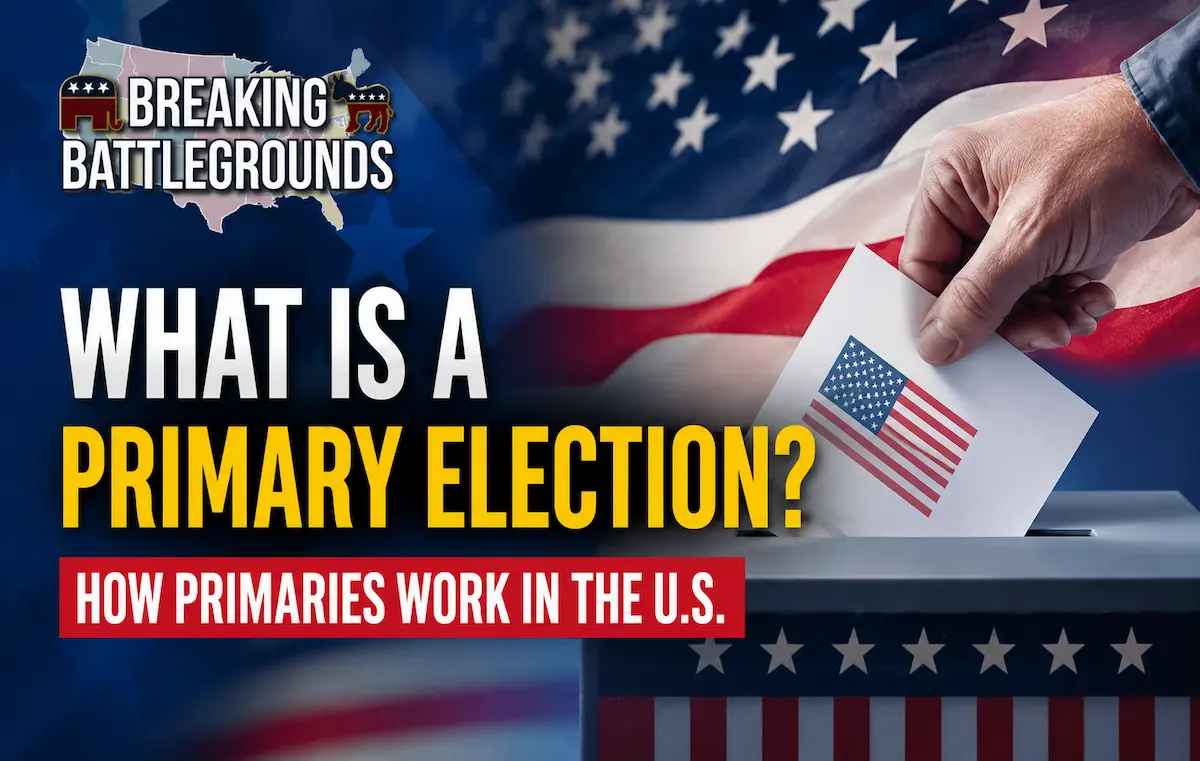
A primary election meaning is fairly simple at its core. Candidates from the same political party compete against each other, and voters choose which one should represent that party on the November ballot.
States run these elections through their own election offices, not the federal government. The Federal Election Commission oversees campaign finance rules for federal candidates, but it has no authority over how a state administers its primary. That distinction matters, because it explains why primary rules differ so dramatically from one state to the next.
Most primaries award the nomination to whichever candidate wins the most votes, even without a majority. About ten states take a different approach and require a true majority, triggering a runoff between the top two finishers when no one clears 50 percent. Georgia is a good example. Its 2026 primary is scheduled for May 19, with any necessary runoff held June 16, ahead of the November 3 general election.
Voter registration deadlines also shape who can participate. Depending on the state, a voter may need to register with a party weeks or months before primary day, or may be able to declare a party affiliation right at the polling place.
The Different Types of Primaries
Primary rules fall into several broad categories. Some are set by state law, and others are left to each party’s own internal rules, which is why the two major parties sometimes use different systems within the same state.
Closed Primaries
In a closed primary, only voters registered with a party can vote in that party’s primary. A Republican cannot vote in the Democratic primary, and the reverse is also true. As of early 2026, 13 states required closed primaries by law, with Oklahoma law explicitly barring participation by voters not registered with the party. Louisiana is moving toward this model as well. Under a law passed in 2024, the state’s traditional “jungle primary” for Congress will shift to closed party primaries beginning in 2026, meaning candidates from each party will compete in separate contests before the general election.
Open Primaries
An open primary lets any registered voter, regardless of party, choose which party’s primary ballot to request. Fourteen states currently require open primaries. Texas, Wisconsin, and Virginia are among the states where any voter can walk in and pick a party’s ballot on primary day.
Semi-Closed Primaries
A semi-closed primary sits between the two. Registered party members can only vote in their own party’s primary, but unaffiliated or independent voters are also allowed to participate. Ten states use this hybrid model. Arizona is one of them: independents can request either party’s ballot, but a registered Democrat cannot vote in the Republican primary
Top-Two and Top-Four Primaries
California and Washington use a top-two system, sometimes called a jungle primary, where every candidate from every party appears on a single ballot and the top two finishers advance to the general election regardless of party. Alaska goes further with a top-four system that sends the four leading finishers to a ranked-choice general election.
Primary Type | Who Can Vote | States Using It (2026) | Example |
Closed | Registered party members only | 13 states | Florida, Pennsylvania |
Open | Any registered voter | 14 states | Texas, Wisconsin |
Semi-closed | Party members plus unaffiliated voters | 10 states | Arizona, Colorado |
Top-two / Top-four | All voters, all candidates on one ballot | CA, WA, AK | — |
Primary Election vs. General Election
A primary vs general election comparison comes down to purpose. A primary narrows the field within each party. A general election decides who actually holds the office, pitting the nominees who emerged from each party’s primary against each other along with any independent or third-party candidates.
Turnout tells the story of how differently voters treat these two elections. General elections, especially in presidential years, draw far more participants than primaries do. Primary turnout varies by state and by how competitive the local races are, but it consistently lags far behind the November vote. That gap fuels much of the debate over the current primary system, covered further below.
Presidential Primaries Work Differently
Presidential primaries add another layer of complexity. Voters in a presidential primary are not choosing the nominee directly. They are selecting delegates who are pledged, in most cases, to support a specific candidate at the party’s national nominating convention. Party rules, not state election law, largely determine how those delegates are allocated and whether they remain bound through multiple convention ballots.
Some states hold their presidential and congressional primaries on the same day. Others, like Wisconsin historically, have separated them by months, or even years apart from other primary contests. A handful of states still use caucuses instead of primaries for the presidential nominating process, though the number relying solely on caucuses has shrunk considerably over the past two decades.
The 2026 Primary Season: What's at Stake
The stakes in 2026 are unusually high. All 435 U.S. House seats and 35 Senate seats are on the ballot, including two special Senate elections tied to vacancies left when J.D. Vance and Marco Rubio joined the Trump administration. Democrats need a net gain of four Senate seats and three House seats to flip either chamber.
Several marquee primaries illustrate how these contests shape the general election. In Kentucky, Senate Republican leader Mitch McConnell chose not to seek another term after more than four decades in the chamber, opening a crowded primary in both parties. In Ohio, Sen. Jon Husted, appointed to fill Vance’s seat, faces a Republican primary ahead of a likely general election matchup with Democrat Sherrod Brown. In Alabama, Sen. Tommy Tuberville opted to run for governor rather than seek re-election, creating another open Senate primary in a heavily Republican state. Georgia’s Senate primary will determine who challenges Democratic incumbent Jon Ossoff in a state Donald Trump carried in the 2024 presidential election.
Super Tuesday, March 3, 2026, brought the largest single-day cluster of primaries, including contests in California, Texas, and North Carolina. The primary calendar runs through mid-September in some states, with the general election set for November 3, 2026.
The Push to Change How Primaries Work
Primary rules are not settled law carved in stone. Reform advocates, including the group Unite America, argue that low-turnout closed primaries let a small, ideologically driven slice of the electorate pick nominees who do not reflect the broader electorate. The group’s research found that roughly 8 percent of voters effectively elected 83 percent of the U.S. House in 2022, a figure it attributes to safe districts decided in low-turnout primaries rather than competitive general elections.
Ballot initiatives to open up primary systems have appeared in several states in recent cycles, including Arizona, Idaho, Nevada, and Colorado. Supporters say open and top-two systems reduce the influence of the most partisan primary voters and produce nominees with broader appeal. Critics, including many state party organizations, counter that closed primaries protect a party’s right of association and prevent voters from a rival party from influencing its nomination, a practice often called crossover voting. Louisiana’s move to close its congressional primaries starting in 2026 reflects that same underlying tension between party control of the nomination and broader voter access to it. Reasonable people disagree on which trade-off serves voters better.
Related Breaking Battlegrounds Discussion
Primary mechanics are not an abstract topic on this show. Hosts Sam Stone and Chuck Warren have covered Arizona’s primary system directly, including a conversation with Andy Gould and Maricopa County Recorder Stephen Richer on Arizona’s primary election, part of the show’s extensive AZ Primary Interviews series featuring candidates across the state’s federal, statewide, and legislative races. Listeners looking for on-the-ground reporting on how these rules actually play out in a competitive state should start there.
Frequently Asked Questions
What is a primary election?
A primary election is a state-run vote in which a political party’s supporters choose the candidate who will represent that party in the general election. Rules on who can vote vary by state and by party.
What is the difference between an open primary and a closed primary?
An open primary lets any registered voter choose which party’s ballot to use. A closed primary restricts voting to people already registered with that party, excluding independents and members of other parties.
How do primary elections work in presidential races?
Presidential primaries let voters choose delegates pledged to a candidate rather than the nominee directly. Those delegates then formally select the nominee at the party’s national convention over the summer.
Why does the primary election meaning matter for voters?
Primaries determine which candidates appear on the November ballot, so they often decide the real outcome in safely Democratic or Republican districts where the general election is not competitive.
What is the difference between a primary and a general election?
A primary narrows the field within each party and typically draws far lower turnout. A general election decides who holds office and includes nominees from all parties plus any independents on the ballot.
Conclusion
Primary elections decide far more than most voters realize, especially in the safe districts that make up most of Congress. The rules governing who can vote in them, whether closed, open, semi-closed, or top-two, shape which candidates survive to the general election and, in many cases, who ultimately wins office. With control of the House and Senate both within reach in 2026, this year’s primaries carry more weight than usual, and the debate over whether primaries should be opened up further is unlikely to fade soon.
Related Reads
Sources
- Ballotpedia, “Primary Election Types by State,” accessed 2026
- National Conference of State Legislatures, “State Primary Election Types”
- S. Vote Foundation, “When Are the 2026 Midterm Elections? And What Is Their Purpose?”
- Bipartisan Policy Center, “The 2026 Midterms: Key Dates and Events”
- Louisiana Secretary of State, “Closed Party Primary Elections”
- Federal Election Commission, “Public Funding of Presidential Elections”
- Congressional Research Service via Congress.gov, “2024 Presidential Nominating Process: Frequently Asked Questions”
- CBS News Atlanta, “Georgia Expected to Play Pivotal Role in 2026 Midterm Elections”
- Fox News, “‘Polarizing’ Way of Picking Party Nominees Targeted in Ballot Questions in These 6 States”
Editorial Note: This article is intended for informational and analytical purposes. Political developments, policies, polling, and public statements can change over time. Readers should consult primary sources and official government information for the latest details.