A podcast episode that loses 60 percent of its audience in the first ten minutes is not a content problem, it is a structure problem. The content may be excellent, the guest may be world-class, and the audio quality may be professional. None of that matters if the structural pacing does not give listeners a reason to stay.
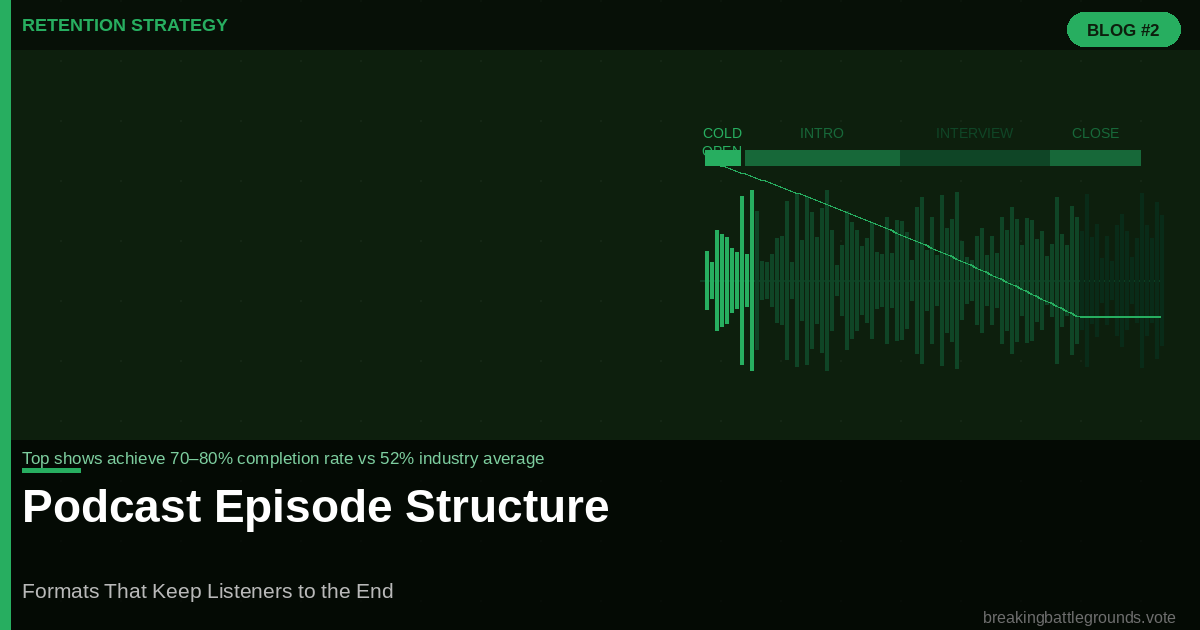
Podcast analytics are brutally honest about this. Apple Podcasts and Spotify both provide episode completion rate data. The industry average completion rate for podcast episodes over 40 minutes is 52 percent. The best shows consistently achieve 70 to 80 percent completion on the same episode lengths. The difference between those two numbers is almost entirely structure.
The Three Episode Structures That Drive the Highest Completion Rates
Structure 1: The Cold Open Interview Format
This format is used by the highest-retention interview podcasts including How I Built This, Armchair Expert, and Breaking Battlegrounds. The structure:
- Cold Open (0:00 to 0:45) — Pull the single most interesting 20 to 40 seconds from the middle of the interview. Do not explain it. Do not introduce it. Just play it. Listeners are immediately oriented around the episode’s most compelling content.
- Host Intro (0:45 to 2:00) — Brief host identification and today’s episode framing. Maximum two sentences.
- Guest Introduction (2:00 to 4:00) — Guest bio delivered conversationally, not read from a press release. The best introductions are 60 to 90 seconds and establish why this specific guest matters for this specific conversation.
- The Interview (4:00 to the episode end minus 5 minutes) — Organized around three to five central questions, not a linear biography of the guest.
- Closing Summary (last 3 to 5 minutes) — Host synthesizes the two or three most actionable or surprising things from the conversation. Listener leaves with a clear takeaway.
Structure 2: The Problem-Solution-Action Format
This is the dominant structure for educational and solo host podcasts. It mirrors the structure of a well-organized essay: state the problem clearly, develop the solution with evidence, provide a specific action the listener can take immediately.
The critical execution detail: the problem statement must be specific enough that a listener immediately recognizes their own situation in it. ‘Podcasters struggle to grow’ is too broad. ‘You have been publishing consistently for six months and your downloads haven’t moved’ is specific enough to stop a qualifying listener mid-scroll.
Structure 3: The Narrative Arc Format
This is the most demanding format to produce and the highest-retention when done well. Serial, Radiolab, and This American Life use it. The episode follows a story with a beginning, escalating complication, and resolution. Every segment introduces a new development that forces the listener forward.
The narrative arc format requires more scripting, more post-production editing, and more structural planning than interview or educational formats. For podcasters with journalism or storytelling backgrounds, it is worth the investment. For everyone else, the cold open interview format produces nearly equivalent retention with significantly less production effort.
The First 90 Seconds: The Only Metric That Matters for Retention
90 sec Decision window — stay or leave | 61% Of drop-offs happen before minute 5 | 23% More retention with cold
| 52% Average industry completion rate |
Edison Research’s 2026 podcast consumption data shows that 61 percent of episode abandonment happens before the five-minute mark. The listener has enough data in those five minutes to determine whether the episode is worth their time. The cold open exists specifically to frontload the most valuable content into that window.
The common structural mistakes that cause early drop-off are predictable. Long musical intros (anything over 15 seconds is too long in 2026). Extended host monologues before getting to the guest. Lengthy biographical introductions that tell listeners what the guest has done rather than what they are going to learn. Advertisements placed in the first three minutes before listener investment is established.
Segment Length: The Pacing Formula That Holds Attention
Attention operates in natural rhythmic cycles. Cognitive research on lecture and presentation retention shows attention peaks roughly every 10 to 12 minutes before naturally dipping. The best podcast formats exploit this rhythm by introducing a new element, segment, or development every 8 to 12 minutes.
For interview podcasts, this means the host should introduce a new major question or topic shift every 8 to 12 minutes. Listeners who are accustomed to this rhythm develop an implicit expectation of novelty at those intervals. When novelty arrives on schedule, completion rates increase. When a single topic runs for 25 minutes without development, drop-offs spike.
For solo educational podcasts, vary the content delivery mode every 8 to 10 minutes: shift from explanation to example, from principle to data, from abstract concept to concrete story. The content can be continuous, but the delivery mode should change. Auditory variety maintains engagement the same way visual variety maintains attention on video.
Show Notes as a Structural Tool
Most podcasters treat show notes as an afterthought, a list of links published because the hosting platform has a field for it. The podcasters with the highest retention and subscriber conversion rates treat show notes as a structural extension of the episode itself.
Effective show notes include a 150-word summary that functions as a standalone article, timestamped chapter markers (which Apple Podcasts and Spotify both display natively), three to five key takeaways in bullet form, and every resource, book, or person mentioned in the episode with a hyperlink. This structure serves two purposes: it improves SEO by giving search engines substantive text to index, and it increases the likelihood that a casual visitor converts to a subscriber after reading the notes before listening to the episode.
Frequently Asked Questions
How long should a podcast episode be?
Episode length should match the content’s natural conclusion, not a predetermined time target. That said, Edison Research 2026 data shows optimal engagement for interview podcasts between 35 and 65 minutes. Solo educational podcasts perform best at 20 to 40 minutes. Political and current events podcasts retain audiences longest at 45 to 75 minutes.
Should I script my podcast or speak freely?
Neither extreme produces the best result. Full scripting sounds unnatural in audio format. Completely unscripted shows accumulate filler words, lose structural coherence, and require more editing time. The best format is a detailed outline (each major question and its sub-points) with scripted opening and closing segments.
Where should I place advertisements in my podcast?
Post-roll (after the episode ends) ads have the lowest completion rate. Pre-roll ads placed in the first three minutes lose listeners before investment builds. Mid-roll ads placed between natural segment breaks at the 20-30 minute mark perform best. Host-read mid-roll ads integrated into conversation outperform dynamically inserted pre-recorded spots by 3 to 4 times on engagement metrics.
What is a cold open in podcasting?
A cold open is a 20 to 45 second clip from the middle of the episode played before any introduction, music, or sponsor message. It is designed to immediately demonstrate the value of the episode and give listeners a compelling reason to continue. Research from Chartable shows episodes with effective cold opens average 23 percent higher completion rates.