A Note on Authority
I work at the Maricopa County Recorder’s Office, one of the most closely scrutinized election administration offices in the country. I have managed campaigns and observed election administration from both the practitioner side (as a campaign professional) and the administrative side (as a county official). What follows is not a pundit’s analysis. It is an account of what election integrity proposals actually mean at the county level where elections are run.
The Five Core Conservative Proposals
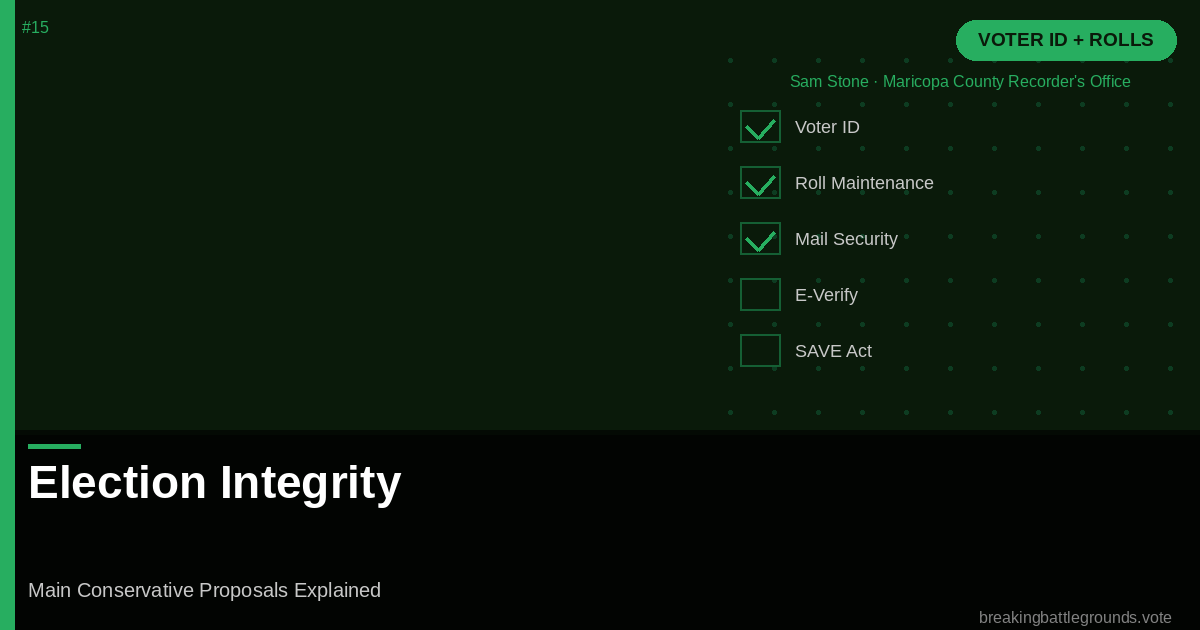
Voter ID requirements are the most consistently supported conservative election integrity proposal. The argument: voting is a fundamental right that, precisely because of its importance, should be subject to identity verification. Every major democracy that administers free elections, including countries widely regarded as having strong democratic traditions, uses some form of voter ID. The United States is an outlier in having no federal ID requirement.
Voter roll maintenance addresses the accuracy of voter registration lists. Conservative proposals call for regular use of the ERIC (Electronic Registration Information Center) data system or comparable tools to remove deceased voters, voters who have moved out of jurisdiction, and duplicate registrations. Accurate voter rolls reduce the opportunity for administrative errors and fraudulent registration activity.
Mail ballot security proposals address chain-of-custody documentation, signature verification standards, and ballot drop box location and monitoring requirements. These proposals are not about eliminating mail voting, which Republican voters use at significant rates, but about ensuring that mail ballots have the same documentary support and verification steps as in-person votes.
Counting timeline standardization addresses the extended ballot-counting periods that have emerged in recent election cycles. Conservative proposals would require ballots to be returned by Election Day and counted within 24 to 48 hours of polls closing. The argument is that extended counting windows create public confidence problems regardless of their administrative justification.
Third-party ballot collection restrictions, sometimes called ‘ballot harvesting’ restrictions, address the practice of having campaign volunteers or paid workers collect completed mail ballots from voters. Conservative proposals restrict this practice to family members or official election workers, arguing that third-party collection creates an unmonitored link in the chain of custody.
What These Proposals Look Like at the County Level
At the county level, election integrity proposals translate into administrative requirements: signature verification training for election workers, physical security protocols for ballot drop boxes, IT security requirements for voter registration databases, and post-election audit procedures.
The most contentious practical question at the county level is resource adequacy. Every additional verification step requires either more staff, more time, or both. Counties with limited budgets face genuine tradeoffs between thoroughness and timeliness. Conservative election integrity proposals should include the funding mechanisms necessary to implement them properly at the local level, an element that is often underspecified in the policy debate.
Frequently Asked Questions
What is voter ID and why do conservatives support it?
Voter ID requires voters to present identification before casting a ballot. Conservatives support it as a basic security measure for an important civic act. Most major democracies use some form of voter ID.
What is ballot harvesting and why do conservatives want to restrict it?
Ballot harvesting refers to the practice of collecting completed mail ballots from voters for submission to election officials. Conservative proposals restrict this practice to family members and official election workers to maintain chain-of-custody documentation.
Does election integrity legislation reduce voter turnout?
The research on this question is contested. States with voter ID requirements have not consistently shown lower turnout than states without them. The implementation details, particularly whether free IDs are readily available, appear to matter more than the requirement itself.