Most podcast interviews are predictable. The host asks about the guest’s background. The guest delivers a polished career summary. The host asks about the guest’s work. The guest delivers talking points. The host asks what listeners can learn. The guest promotes something. The conversation is pleasant, forgettable, and adds nothing to what the listener could have read on the guest’s LinkedIn profile.
The best podcast interviews feel like conversations between two people who genuinely want to understand something together. They produce moments of surprise, tension, specific detail, and insight that the listener could not have gotten anywhere else. Those moments do not happen by accident, they happen because the host used specific interview techniques designed to elicit genuine, unrehearsed responses.
Pre-Interview Research: The Foundation of Great Questions
The quality of your questions determines the quality of your answers, and the quality of your questions is determined by the depth of your pre-interview research. Surface research produces surface questions which produce surface answers. Deep research produces questions that reveal something about the guest they have not been asked before.
The Three-Layer Research Framework
- Layer 1 — Public record: Everything the guest has written, said, or published publicly. Articles, previous interviews, books, speeches, social media posts. Search specifically for positions the guest has taken that are in tension with each other, claims they have made that were later contradicted by events, and opinions they held earlier in their career that differ from their current position.
- Layer 2 — Audience perspective: What does your audience already know about this guest? What would they most want to know that the guest has never been directly asked? Listen to three or four previous interviews with this guest and make a list of every question they were asked. Your questions should specifically not duplicate any of them.
- Layer 3 — Structural tension: Every person’s professional life contains genuine tensions, between what they believed and what they discovered, between what they wanted to do and what constraints required, between their public position and their private doubts. Research that surfaces these tensions produces the questions that generate memorable answers.
The Five Question Types That Unlock Real Answers
1. The Specific Moment Question
‘Walk me through the specific day or moment when X happened’ forces the guest out of generalization and into specific memory. Specific memories contain specific details. Specific details are credible, memorable, and impossible to produce with talking points. Politicians and executives are trained to answer in principles and generalities; a specific moment question bypasses that training.
2. The Counterfactual Question
‘If you had known then what you know now, what would you have done differently?’ reveals genuine reflection rather than post-hoc rationalization. The counterfactual forces the guest to acknowledge a gap between their beliefs and reality, the most fertile ground for honest conversation. Breaking Battlegrounds’s conversations with policy makers and former officials work well with this framework because government experience consistently produces these gaps.
3. The Contradiction Question
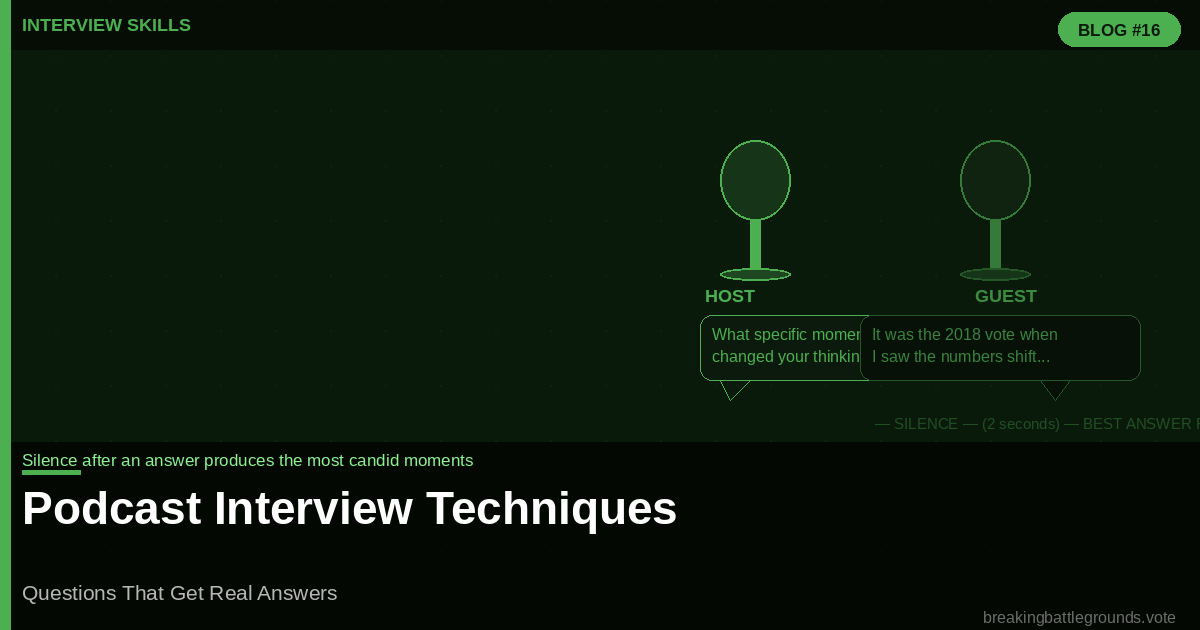
‘You said X in 2018 and now you are describing Y, what changed your thinking?’ requires the guest to engage with their own intellectual history rather than presenting a static current position. Most guests have been on intellectual journeys that are more interesting than their current settled positions. The contradiction question invites them to tell that story.
4. The Steelman Question
‘What is the strongest version of the argument against your position?’ separates thinkers from advocates. A guest who can articulate the best case against their own position demonstrates genuine intellectual engagement with the subject. A guest who cannot, reveals that they are operating as an advocate rather than as an analyst. Either answer is useful.
5. The Silence
The most underused interview technique is not a question, it is silence after an answer. When a guest finishes a response, most hosts immediately ask the next question. Waiting 2 to 3 seconds before speaking communicates that you are thinking about what they said. Guests, uncomfortable with silence, often fill it with the most candid thing they say in the entire interview. Practice comfortable silence. It produces more genuine content than any prepared question.
Handling Difficult Interview Moments
Three difficult scenarios every podcast host encounters: the rehearsed talking-point answer, the hostile or defensive guest, and the rambling response that has no natural ending.
For talking-point answers: follow up immediately with ‘That’s the general principle, can you give me a specific example where you have seen that play out?’ Specific examples require departing from the talking point. No one has rehearsed specific examples.
For hostile or defensive guests: reduce the threat level by naming it without blame. ‘I want to make sure I’m asking this in a way that’s useful rather than adversarial, let me try the question differently.’ This reframe almost always de-escalates because it demonstrates that the host’s goal is understanding, not confrontation.
For rambling responses: an interruption that sounds like a continuation is the most effective structural tool. ‘Right, and what I’m hearing in that is [summarize the key point]…’ Summarizing and redirecting feels like engagement rather than interruption to the guest and re-focuses the conversation.
Frequently Asked Questions
What makes a good podcast interview question?
Good podcast interview questions are specific rather than general, invite stories rather than positions, and reveal something the guest has not been asked before. The best questions create a moment of genuine reflection in the guest, you can hear them thinking before they answer rather than delivering a prepared response.
How do I prepare for a podcast interview?
Prepare using three research layers: everything the guest has publicly written or said, what your audience already knows and wants to know, and the structural tensions in the guest’s professional story. List every question asked in previous interviews with this guest and deliberately avoid duplicating any of them.
How do I handle a guest who only gives talking points?
Follow every talking-point answer with a specific example request: ‘Can you give me a specific instance where that played out in practice?’ Talking points are prepared in generalities. Specific examples require departing from preparation and engaging with actual experience.
What is the biggest mistake in podcast interviews?
Starting with biographical questions. ‘Tell me about your background’ produces the same answer the guest gives in every interview. Open instead with a specific moment, a tension in their work, or a direct question about something in their recent public statements. The first question sets the intellectual register for the entire conversation.