The sponsorship model has a minimum viable audience problem. Most advertisers require 2,000 to 5,000 downloads per episode before considering a show. The majority of podcasts, including many that produce genuinely valuable, tightly focused content, never reach that threshold. This leaves the impression that podcast monetization is unavailable to smaller shows. It is not.
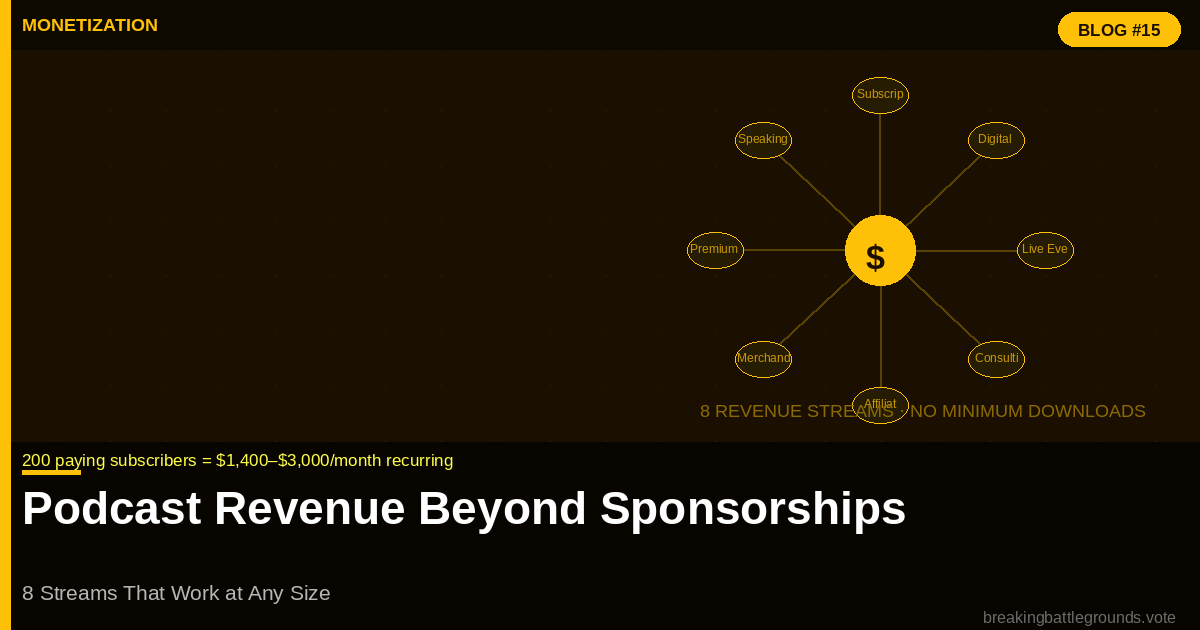
The eight revenue streams below are available to any podcast regardless of download count. Several of them perform better with smaller, highly engaged audiences than with large passive ones. Understanding which model fits your show’s audience type is more important than reaching an arbitrary download threshold.
Stream 1: Listener Subscriptions
$7-15 Typical monthly subscription price | 200 Paying subscribers = $1,400-3,000/mo | 3-8% Typical listener-to-subscriber conversion | $0 Minimum audience to start |
Listener subscriptions convert a percentage of your free audience into paying supporters in exchange for additional value: early access to episodes, bonus content, ad-free listening, direct access to the host, or premium archives. The platforms for this model are Patreon, Substack, Supercast, and Apple Podcasts Subscriptions.
The math is compelling at small audience sizes. A 3 percent conversion rate from 500 free listeners produces 15 paying subscribers at $10 per month, $150 monthly recurring revenue. At 2,000 free listeners with the same conversion rate, that is $600 per month recurring before any advertising. The key insight: you can launch a subscription tier from your first episode if you have a clear articulation of the exclusive value subscribers receive.
Stream 2: Digital Products
Podcasters with subject matter expertise sell digital products to audiences that already trust their knowledge. The most successful podcast digital products are direct extensions of the show’s content: the companion guide to the show’s framework, the template referenced in multiple episodes, the course that expands on the show’s topic, or the resource library of tools mentioned across the archive.
Price points that work for podcast digital products: $9 to $29 for single templates or guides, $49 to $149 for comprehensive toolkits or resource bundles, $199 to $499 for self-paced courses, $999 to $2,999 for live cohort programs. The course model generates the highest revenue per unit but requires the most production investment. Templates and guides generate the best revenue-to-effort ratio for most podcasters.
Stream 3: Live Events and Virtual Workshops
Live events convert podcast audiences into in-person or virtual communities. The revenue potential scales with the audience’s professional composition. A podcast with 5,000 listeners in a specific professional niche can charge $99 to $299 for a three-hour virtual workshop because the audience sees direct professional value in attending. A show with 50,000 general entertainment listeners has a harder time charging the same amount because the value proposition is less specific.
Virtual workshops are the lowest barrier entry point. A 90-minute Zoom workshop for 50 attendees at $79 generates $3,950 revenue with minimal production cost. The primary investment is the host’s preparation time and basic webinar software ($49 to $99 per month for Zoom Webinars or Crowdcast).
Stream 4: Consulting and Services
Podcasts that demonstrate expertise attract clients who want to hire that expertise directly. A conservative political podcast co-hosted by a campaign manager naturally attracts political clients. A cybersecurity podcast naturally attracts corporate clients seeking security consulting. The podcast is the world’s most efficient long-form marketing tool for professional services businesses, each episode is a 45-minute demonstration of the host’s expertise.
This stream requires no setup beyond a contact form on the website. The podcast does the marketing; the host does the work. Many professional services podcasters earn more from clients who found them through the podcast than from all other podcast revenue streams combined.
Streams 5 Through 8: Affiliate Marketing, Merchandise, Premium Archives, Speaking
Affiliate marketing generates commission income from recommending products or services the host genuinely uses. The key: only promote products with genuine relevance to the audience and personal experience using them. Amazon Associates pays 1 to 10 percent commission. Software affiliate programs pay 20 to 40 percent recurring commission. A single software recommendation to a professional audience can generate thousands of dollars in annual recurring commission.
Merchandise revenue from podcast-branded products works best when the brand has cultural resonance beyond the show itself, when fans wear the merch as an identity statement. Print-on-demand services like Printful and Printify eliminate inventory risk and upfront investment.
Premium archives give new listeners access to the full episode backlog behind a paywall. Shows with 100 or more episodes have a genuine archive that new listeners will pay to access. At $5 per month for archive access, 200 subscribers generate $1,000 in monthly recurring revenue from content that already exists.
Speaking engagements follow naturally from podcast credibility. A podcast host who has interviewed senators, policy experts, and industry leaders has demonstrated platform-level expertise that event organizers value. Speaking fees for podcast hosts with established shows range from $2,500 to $25,000 per engagement depending on the audience and topic.
Frequently Asked Questions
Can a small podcast make money?
Yes. Listener subscriptions, digital products, affiliate marketing, consulting, and speaking engagements all generate revenue independent of download volume. A 500-listener podcast with a highly engaged niche audience can generate more monthly revenue than a 50,000-listener podcast with passive general interest listeners.
What is the best podcast monetization platform?
For subscriptions: Substack combines newsletter and paid subscription in one platform and is the strongest option for shows with intellectual or analytical content. For courses: Teachable or Thinkific. For affiliate marketing: individual program applications through software companies and Amazon Associates. For merchandise: Printful or Printify for print-on-demand with no inventory risk.
How many listeners do you need to make money podcasting?
Sponsorship models require 2,000 to 5,000 listeners per episode minimum. Direct-to-audience models (subscriptions, digital products, consulting, affiliate marketing) have no minimum audience requirement. A podcast with 300 highly engaged listeners in a professional niche can generate meaningful monthly income from subscriptions and consulting inquiries.
What is affiliate marketing for podcasters?
Affiliate marketing for podcasters means recommending products or services to listeners and earning a commission on sales made through your referral link. Commissions range from 1 to 10 percent for physical products (Amazon Associates) to 20 to 40 percent recurring for software subscriptions. The most effective affiliate promotions are for products the host genuinely uses and can describe from personal experience.