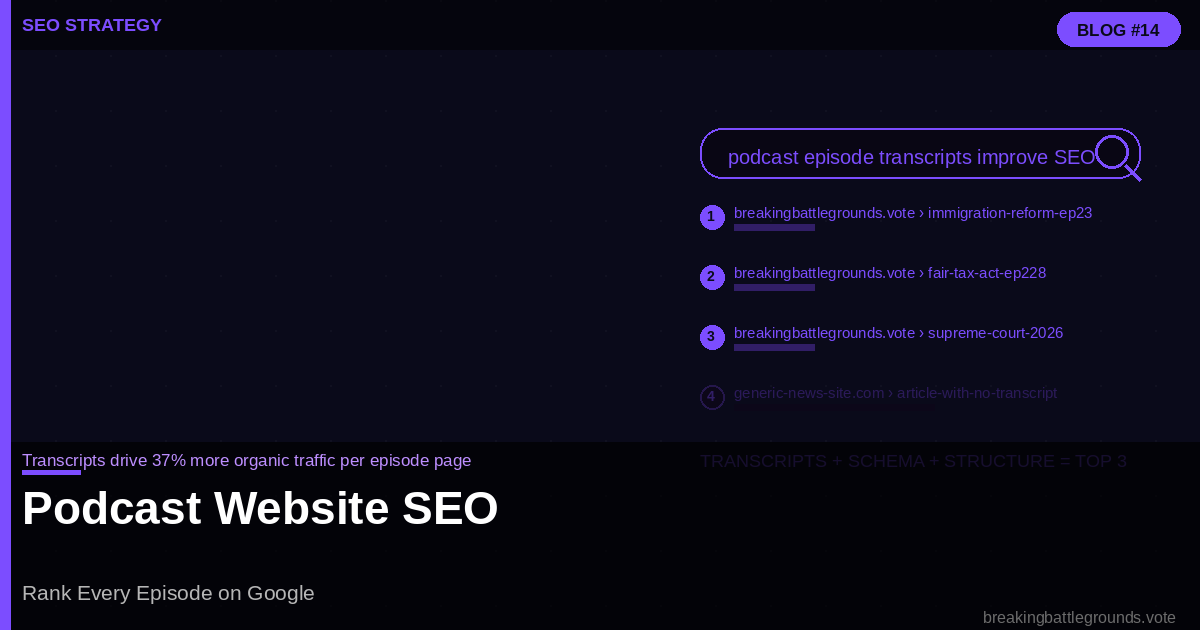
A podcast without a website is invisible to Google. Audio files produce zero organic search traffic on their own. The entire SEO opportunity of a podcast, and it is substantial, given that a 45-minute episode generates 6,000 to 9,000 words of unique content, depends entirely on whether that content has been given a text layer that Google can crawl, index, and rank.
This guide covers every technical and on-page SEO element that turns a podcast website from a decorative presence into a traffic-generating asset. The implementation is not complex. Most of it requires one-time setup and a repeatable per-episode workflow that takes 20 to 30 minutes.
The Individual Episode Page: The Foundation of Podcast SEO
Every episode needs its own dedicated URL page, not a feed aggregator, not a single page with all episodes listed, but an individual URL for every episode. This is non-negotiable for podcast SEO. Each episode page is a separate indexable asset that can rank independently for its own keyword targets.
Episode Page Structure for Maximum SEO
- Title Tag (60 characters): The episode’s primary keyword plus a differentiating phrase. Not ‘Episode 232’ but ‘Immigration Reform Explained: Former Judge on Deportation Law’.
- Meta Description (160 characters): The answer-first summary of what the episode covers. Include the guest’s name and credentials and the one primary thing the listener will learn.
- H1 Tag: Match or closely parallel the title tag. One H1 per page only.
- Answer-First Opening Paragraph (50 to 70 words): The first paragraph of the show notes should directly answer the episode’s primary question. This is the Google AI Overview extraction target.
- Episode Embed: The audio player embedded on the page keeps visitors on the page (improving time-on-site signals) and gives visitors a reason to engage beyond reading.
- Transcript: Full or edited. Minimum 1,500 words of text on the page. This is the primary SEO content that differentiates your episode page from a directory listing.
- FAQ Section: Five to seven questions and answers using the specific language searchers use. These sections are the most reliable Google AI Overview extraction points on the page.
JSON-LD Schema Markup for Podcasts
JSON-LD schema markup tells Google explicitly what type of content is on each page. For podcast websites, two schema types are critical: PodcastSeries (applied to your main podcast page) and PodcastEpisode (applied to each individual episode page). Adding this schema improves Google’s confidence in categorizing your content and is required for eligibility for podcast-specific search features.
The PodcastEpisode schema should include: episodeNumber, name (episode title), description (the episode summary), datePublished, duration, associatedMedia (the audio file URL), and partOfSeries (linking to the show’s main page schema). WordPress plugins including Yoast SEO Premium and Rank Math both automate this schema generation for podcast pages.
Internal Linking: The Traffic Multiplier
Internal linking between episode pages is the most underutilized SEO tactic in podcasting. Each episode page should link to three to five related episode pages using descriptive anchor text. An immigration reform episode links to the border enforcement episode, the E-Verify analysis episode, and the SAVE Act explainer. This internal linking distributes page authority across the site, increases pages per session, and signals to Google that your site has topical depth on immigration policy rather than isolated posts.
Topical cluster architecture, a pillar page covering a broad topic linked to multiple episode pages covering specific aspects, is the structure that produces the strongest SEO results for podcast websites. A ‘Conservative Immigration Policy’ pillar page linking to seven specific episode pages on immigration sub-topics builds more authority than seven unlinked episode pages competing against each other.
Page Speed and Core Web Vitals
Google’s Core Web Vitals, Largest Contentful Paint, Cumulative Layout Shift, and Interaction to Next Paint, are ranking factors that podcast websites frequently fail because of large unoptimized audio players, heavy cover art images, and slow hosting infrastructure. Test your site at PageSpeed Insights and aim for a score above 70 on mobile. The most common fixes for podcast sites: compress cover art images, use a CDN for audio file hosting, and defer the audio player JavaScript so it does not block initial page rendering.
Frequently Asked Questions
Does my podcast need its own website for SEO?
Yes. A podcast without a dedicated website is invisible to Google. Platform profile pages on Apple Podcasts and Spotify are not indexed in Google search results at the episode level. A website with individual episode pages, transcripts, and proper schema markup is required to generate organic search traffic from podcast content.
What is PodcastEpisode schema markup?
PodcastEpisode is a structured data type that tells Google explicitly that a page contains a specific podcast episode. Adding this JSON-LD schema to each episode page improves Google’s categorization confidence and qualifies the page for podcast-specific search features. WordPress plugins like Yoast SEO Premium and Rank Math automate its generation.
How do I optimize podcast show notes for SEO?
SEO-optimized show notes include a keyword-rich title (not ‘Episode 232’), an answer-first opening paragraph of 50 to 70 words, a full or edited transcript of at least 1,500 words, a FAQ section targeting specific search queries, and internal links to three to five related episode pages. The FAQ section is the most reliable Google AI Overview extraction point on the page.
How long should a podcast episode page be?
A podcast episode page should contain at minimum 1,500 words of text including show notes, transcript, and FAQ content. Pages with 2,500 to 4,000 words of substantive content consistently outrank shorter pages for competitive podcast keywords. More text gives Google more content to index and more potential match points for long-tail search queries.