
What the Fair Tax Act Proposes
The Fair Tax Act would eliminate the federal income tax, payroll taxes (Social Security and Medicare), estate taxes, and gift taxes. In their place, the bill establishes a single national consumption tax of 23 percent on retail sales of goods and services. The Internal Revenue Service would be abolished under the legislation. Tax collection responsibility would shift to state governments, which would receive a fee for administering the tax.
The proposal includes a ‘prebate’, a monthly payment to every American household, scaled to household size, designed to offset the consumption tax on purchases up to the poverty level. Proponents argue this makes the system progressive in practice despite the flat rate.
What Congressman Buddy Carter Said on Breaking Battlegrounds
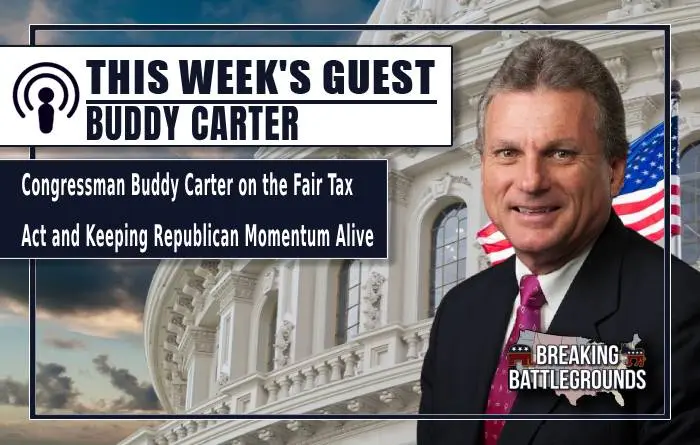
Congressman Buddy Carter of Georgia, one of the Fair Tax Act’s primary sponsors, appeared on Breaking Battlegrounds Episode 228 to make the conservative case for the legislation. Carter argued that the current tax code has grown into a compliance burden that disproportionately affects small businesses and middle-income Americans who cannot afford the sophisticated tax planning available to large corporations.
Carter’s argument centered on transparency and simplicity: when you pay a consumption tax, you see exactly what the federal government is taking with every purchase. The hidden nature of income and payroll taxes, he argued, has allowed the tax burden to grow without the same public accountability that a visible transaction tax would create.
The Conservative Case For
Conservative proponents make four primary arguments. First, economic efficiency: a consumption tax does not penalize work, savings, or investment the way an income tax does. Second, compliance cost reduction: the Fair Tax would eliminate the compliance industry surrounding income tax filing. Third, competitiveness: businesses incorporating in the United States would face no corporate income tax under the proposal. Fourth, transparency: the prebate mechanism explicitly addresses the regressivity concern rather than hiding it through complex deductions.
The Conservative Case Against
Not all conservatives support the Fair Tax. The primary conservative objection is transition risk: eliminating the income tax and establishing a new system simultaneously creates a window of uncertainty about federal revenue. A second concern is the 23 percent rate, which some economists calculate would need to be higher (closer to 30 percent on a tax-inclusive basis) to be revenue-neutral. A third concern is the prebate itself, which critics argue creates a new universal payment program that could be expanded over time.
Current Status
The Fair Tax Act has been introduced in multiple congressional sessions. It has not advanced to a floor vote. In the current Congress, its prospects depend on whether House leadership chooses to bring it to the floor as part of a broader tax reform agenda. Congressman Carter continues to advocate for it as a long-term structural reform rather than an immediately passable bill.
Frequently Asked Questions
What is the Fair Tax Act?
The Fair Tax Act proposes replacing all federal income taxes, payroll taxes, estate taxes, and gift taxes with a single 23 percent national retail sales tax, along with a monthly prebate payment to every American household.
Would the IRS be abolished under the Fair Tax?
Yes. The Fair Tax Act includes a provision to abolish the Internal Revenue Service. Tax collection responsibility would shift to state governments.
Who supports the Fair Tax Act?
Conservative Republicans, particularly those focused on tax simplification and economic growth. Congressman Buddy Carter of Georgia is one of the bill’s most prominent sponsors and advocates.