Audio is invisible to search engines. Google cannot crawl an MP3 file and determine that it contains an authoritative explanation of immigration law from a former federal judge, a detailed breakdown of Senate race dynamics from an experienced campaign manager, or a first-hand account of Taliban captivity from an award-winning journalist. Without a text layer, none of that authority is indexed, ranked, or surfaced to the 7.5 billion people who use Google.
A 45-minute podcast episode, transcribed, generates between 6,000 and 9,000 words of content. At standard blog publishing rates, producing that volume of original, expert-driven content would cost $300 to $900 per episode. The transcript gives you that content for the price of transcription, and AI-powered tools have reduced that cost to near zero in 2026.
The SEO Value of Transcripts: The Data
6,000+ Words per 45-min episode transcribed | 37% More organic traffic with transcripts | $0.25/min AI transcription cost (Descript, Whisper) | 95%+ Accuracy from leading AI tools in 2026 |
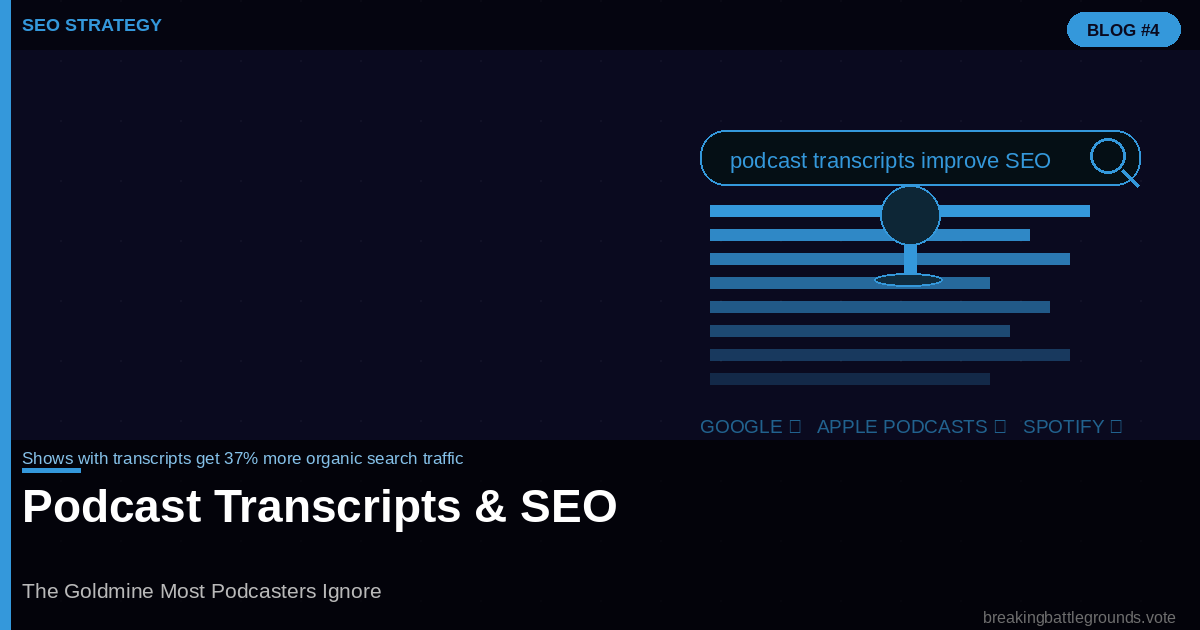
Buzzsprout’s 2026 podcaster survey found that shows publishing full episode transcripts received 37 percent more organic search traffic than comparable shows relying on show notes alone. The mechanism is straightforward: each transcript contains hundreds of specific keywords, named entities, and conversational phrases that match the long-tail queries real people type into Google.
A Breaking Battlegrounds episode featuring a former immigration judge discussing expedited removal, asylum court backlogs, and E-Verify generates natural mentions of those specific terms throughout the transcript. Someone searching ‘what is expedited removal in immigration law’ is searching for exactly the content in that episode. Without the transcript, Google has no way to match that searcher to that episode.
The Three Transcript Publishing Models
Model 1: Full Verbatim Transcript
The complete transcript published as a blog post or dedicated page. Includes all speech, including filler words, corrections, and conversational asides. SEO value: maximum. User experience: moderate, because unedited transcripts are harder to read than polished articles.
Best for: Shows with significant named guests, highly technical content, or policy discussions where verbatim accuracy matters. Legal, medical, and political podcasts benefit most from full verbatim transcripts.
Model 2: Edited Summary Transcript
The transcript is edited for readability, filler words removed, sentence fragments completed, speaker labels added, and section headers inserted at natural breaks. The result reads as a polished article while retaining the conversational depth of the episode. SEO value: high. User experience: high.
Best for: Interview podcasts, educational shows, and any show with guests who have followings that might discover the episode through search rather than the podcast feed.
Model 3: AI-Generated Chapter Summary
Rather than publishing the full transcript, use AI to generate structured chapter summaries from the transcript, 100 to 200 words per major topic segment, with the timestamp for each. This creates scannable content that serves both SEO purposes and listener navigation. SEO value: moderate. User experience: very high.
Best for: Shows with multiple segments, news shows, and podcasts that cover multiple unrelated topics in a single episode.
The AI Transcription Workflow for 2026
Transcription tools have reached a quality threshold in 2026 that makes manual transcription unnecessary for most podcasting use cases. The leading tools and their relevant characteristics:
- Descript — The most integrated tool for podcasters. Transcription accuracy exceeds 95 percent on clear audio. The editor lets you correct the transcript and simultaneously corrects the audio. Direct export to blog post format. Cost: $24/month for Creator plan.
- OpenAI Whisper — Open source, free, and exceptionally accurate on clear audio. Requires technical setup but can be self-hosted for zero per-episode cost. Best for technically capable podcasters or teams with a developer.
- ai — Strong accuracy, good for live recording transcription, and includes meeting notes features. Cost: $16.99/month for Pro plan.
- com — Human transcription available at $1.50/minute. Use for episodes where accuracy is mission-critical — legal content, medical discussions, or episodes where a transcription error could cause reputational harm.
- Castmagic — Transcription plus AI-powered content generation. Produces show notes, social media posts, newsletter content, and blog post drafts from the transcript automatically. $23/month. Strong value for content-hungry podcast teams.
Structuring Transcripts for Maximum SEO Impact
A raw transcript published without structure captures search traffic but converts visitors poorly. A structured transcript captures the same traffic and converts significantly better. The difference is in how you organize the page.
The SEO-optimized transcript page structure: H1 title containing the primary search keyword (the episode’s main topic, not the episode number or generic ‘Episode 232’). A 150-word introduction that frontloads the episode’s most valuable content. H2 headers at each major topic shift (which also function as timestamp markers). Bolded key terms throughout the text. A FAQ section at the bottom addressing common questions the episode answers. Internal links to related episode pages and topic cluster pages.
Frequently Asked Questions
How much does podcast transcription cost?
AI transcription tools like Descript cost $24/month for unlimited transcription. OpenAI Whisper is free and open source. Human transcription through Rev.com costs $1.50/minute of audio. A 45-minute episode costs $67.50 for human transcription or effectively zero with AI tools.
How accurate are AI podcast transcripts in 2026?
Leading AI transcription tools achieve 95 to 98 percent accuracy on clean audio from a quality microphone in a quiet environment. Accuracy drops to 85 to 90 percent with background noise, heavy accents, or multiple overlapping speakers. Human transcription remains the gold standard for accuracy-critical content.
Should I publish the full transcript or just a summary?
Publish both. The full transcript serves SEO by providing maximum indexable content. The edited summary serves user experience by making the content readable. Many shows publish the summary as the primary page with a ‘read full transcript’ toggle or link that loads the complete text.
Do transcripts help with podcast accessibility?
Yes. Transcripts are the primary accessibility tool for deaf and hard-of-hearing listeners, non-native speakers who follow written text more easily than spoken audio, and any listener in a situation where audio is impractical. ADA compliance for podcasts, while not legally mandated in most jurisdictions, is increasingly expected by corporate sponsors and institutional listeners.